Domain name disputes come in more varieties than most people expect, and the most common mistake is choosing the remedy before identifying the type. A trademark owner facing a cybersquatter, a company whose domain was stolen, two co-founders arguing over the company name, and a business whose web developer will not hand over the domain are all in a domain dispute, yet only the first belongs in a UDRP proceeding. This guide is a taxonomy: each kind of dispute, its forum, its remedy and how fast it moves. Domain name dispute resolution works when the dispute is matched to the right procedure.
Trademark owner versus cybersquatter
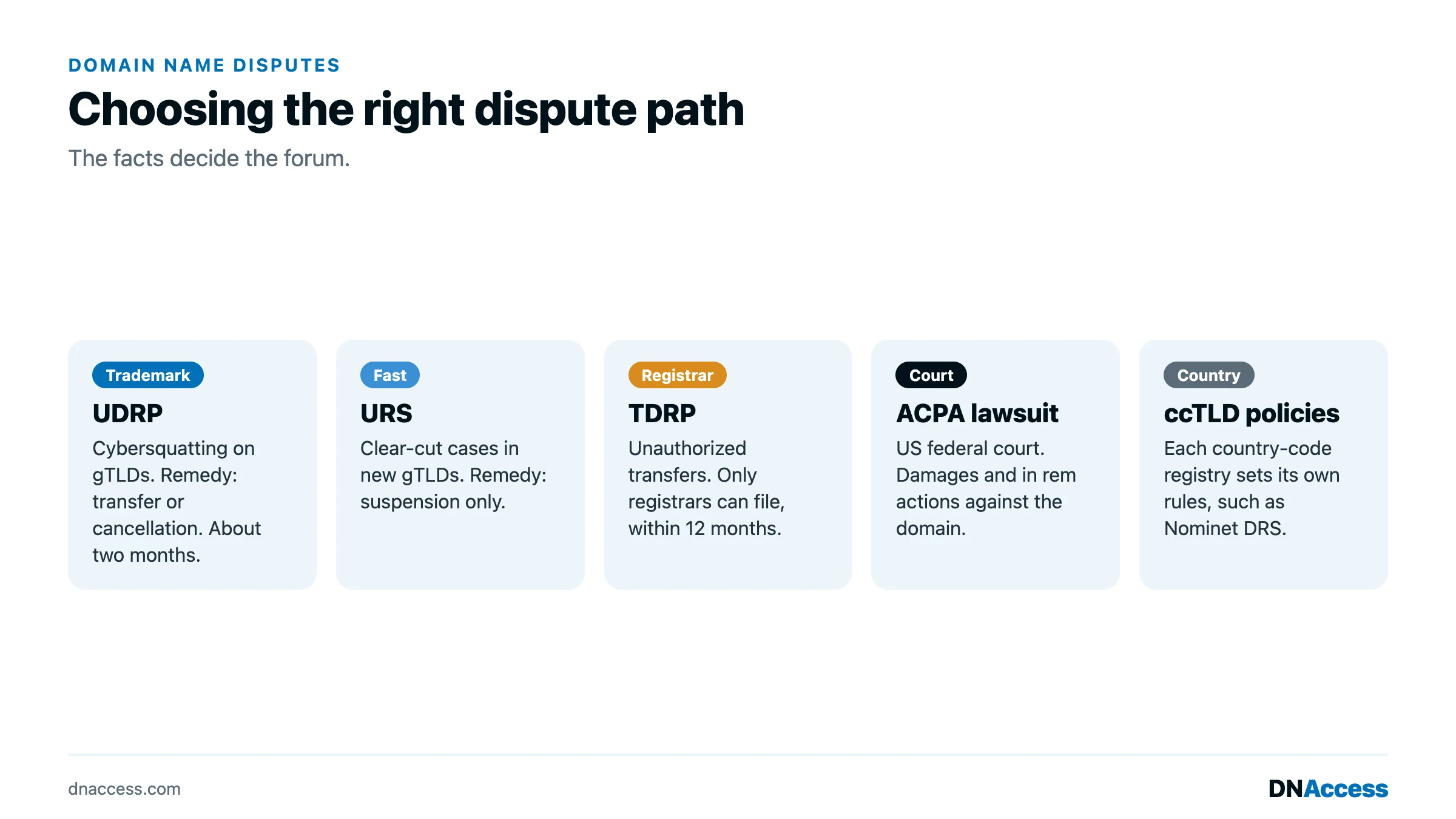
This is the dispute the system was built for: someone registers a domain that matches or resembles a trademark and uses it to profit from the mark. The remedies are three. The UDRP (Uniform Domain-Name Dispute-Resolution Policy) is the ICANN administrative procedure that every gTLD registrant agrees to by contract; a panel can order the domain transferred or canceled, and a contested case usually takes about two months, as our walkthrough of the UDRP process explains. The URS (Uniform Rapid Suspension) is a faster, cheaper procedure limited to new gTLDs and clear-cut cases, and its only remedy is suspension. The ACPA (Anticybersquatting Consumer Protection Act) is a US federal statute that allows a lawsuit with damages and discovery. The UDRP handles most cybersquatting disputes because it is global and predictable: complainants obtained the domain in about 78% of cases across all providers between 2013 and 2020, according to the ICANN GNSO’s revised UDRP status report. Our comparison of UDRP, URS and ACPA explains when each one fits.
Stolen domain names
A stolen domain is one moved out of its rightful owner’s registrar account without authorization, usually after phishing or a compromised email account, and then transferred to another registrar or sold. There is no trademark question here, and the UDRP is the wrong tool: a 2005 ICANN SSAC report observed that a UDRP proceeding takes “at least two months” to reach a decision, while a losing registrar has five days to cancel a pending transfer, as documented in SAC007, Domain Name Hijacking: Incidents, Threats, Risks, and Remedial Actions.
The right path runs through the registrars. The losing registrar contacts the gaining registrar’s TEAC (Transfer Emergency Action Contact), a channel every registrar must staff, and ICANN’s Transfer Policy requires a human response “within 4 hours, although final resolution of the incident may take longer,” according to the ICANN Transfer Policy Review working group’s TEAC, TDRP and ETRP briefing. Some registrars also accept a TURF (Transfer Undo Request Form). If the registrars cannot agree, the losing registrar can file under the TDRP, discussed below. When the thief has sold the name to a buyer who refuses to return it, the remedy is a lawsuit for conversion, the civil wrong of taking someone else’s property; the Ninth Circuit held in Kremen v. Network Solutions that a registrant has “an intangible property right in his domain name,” as set out in the Ninth Circuit’s opinion in Kremen v. Network Solutions, 337 F.3d 1024. Our domain hijacking hub and our guide to legal options for domain theft victims cover each step.
Registrar-to-registrar transfer disputes
The TDRP (Transfer Dispute Resolution Policy) is the ICANN procedure for disputes between registrars over whether a transfer complied with the Transfer Policy. Only a registrar may file, not the registrant, and a dispute “must be filed no later than twelve (12) months after the alleged violation,” with the remedy limited to approving or denying the transfer, including returning the domain to the prior registrar, according to the ICANN Transfer Dispute Resolution Policy text. A theft victim must therefore persuade the registrar to file, and within twelve months of the transfer.
Ownership disputes between partners, co-founders and spouses
When a company breaks up, the domain is often registered in one founder’s personal account, and the other founder discovers that the registrar will only speak to the account holder. Divorces follow the same pattern. These are not UDRP matters, because neither side is a cybersquatter; they are contract and property disputes decided by a court, or by arbitration if the operating agreement provides for it, on the strength of the partnership agreement, the corporate records and whose business used the name. The cure is to settle ownership in writing at formation and register domains in an account the company controls.
Developers, agencies and employees holding a domain
A web developer, agency or former employee registered the domain in their own name, the relationship ends, and the domain becomes a bargaining chip. The first step is a demand letter that establishes the company’s rights and puts the holder on notice. If the holder demands payment to release the name, the ACPA applies: in DSPT International v. Nahum, the Ninth Circuit affirmed a $152,000 verdict against a former employee who withheld his employer’s domain to extract disputed commissions, holding that using a domain “with a bad faith intent to profit from the protected mark by holding the domain name for ransom” is cybersquatting, as recorded in the Ninth Circuit’s opinion in DSPT International, Inc. v. Nahum. A UDRP complaint can also work when the company has trademark rights, and we describe the sequence in our post on recovering a domain name held for ransom.
Expired domains caught by someone else
A domain that lapses passes through a grace period and a redemption period before it is deleted and, very often, caught by a drop-catching service. The new registrant did nothing wrong by registering an available name, so the former owner has no theft claim. The remedy is negotiation and purchase, sometimes through a broker; a UDRP complaint becomes viable only where the former owner holds a trademark and the new registrant is trading on it. Our expired domain name recovery service covers both.
Personal names and celebrity disputes
A personal name is protected under the UDRP only when it functions as a trademark, meaning the public associates it with goods or services. Performers, authors and athletes often qualify; a private individual usually does not. In the United States the ACPA adds a narrow provision against registering a living person’s name to sell it for profit, which does not require a trademark but offers only transfer or injunctive relief. A person whose name was registered by a fan, a critic or a namesake generally has no claim, and the honest answer is often to buy it.
Disputes over ccTLDs
Country-code top-level domains such as .uk, .de, .ca and .au are not bound by the UDRP. Each national registry sets its own dispute policy; many have adopted a version of the UDRP or appointed WIPO to administer a local variant, some run their own procedures with different elements and remedies, and a few leave everything to the courts. Before acting on a ccTLD domain, confirm which policy governs it and whether the registry requires a local presence to hold the name.
Litigate or settle
Litigation makes sense when the dispute needs something a panel cannot give: damages, discovery into who is behind a registration, or a binding ruling on ownership between two legitimate claimants. A UDRP or URS proceeding makes sense when the goal is the domain itself and the evidence is clear on paper. Settlement, including simply buying the name, makes sense when the other side’s position is defensible or winning would cost more than the domain is worth. A registrant who receives a complaint should take the same inventory: documented legitimate use wins cases, and some 7,000 UDRP cases have been dismissed in favor of the registrant at WIPO alone, according to the WIPO-ICA UDRP Review Project Team’s initial report.
Evidence and expert testimony
Every dispute above turns on the same evidence: the registration history, the sequence of registrants in the WHOIS history (archived copies of the public registration record), the DNS history showing where the domain pointed and when, and archived page content showing how it was used. That record establishes whether a transfer was authorized, whether a registrant knew of a mark and whether a name was used for a genuine business; our WHOIS history page explains how it is reconstructed. In court, that record usually has to be interpreted by an expert who can explain registrar systems, transfer mechanics and DNS to a judge or jury, a role I have served in domain name litigation.
Domain name disputes at a glance
| Dispute type | Forum | Remedy | Typical speed |
|---|---|---|---|
| Trademark owner versus cybersquatter | UDRP or URS provider, or US federal court | Transfer or cancellation; suspension under URS; damages under the ACPA | Weeks for URS, about two months for UDRP, longer in court |
| Stolen domain | Registrars (TEAC, TURF), then TDRP or court | Reversal of the transfer; conversion damages in court | Hours to weeks at the registrar; months in court |
| Registrar-to-registrar transfer dispute | TDRP provider, filed by a registrar | Transfer approved or reversed | Weeks to months; must be filed within twelve months |
| Partner, co-founder or divorce ownership | Court or contractual arbitration | Order assigning the domain | Months to years |
| Developer, agency or employee holding a domain | Demand letter, then UDRP or ACPA suit | Transfer; damages under the ACPA | Days if the letter works |
| Expired domain caught by another registrant | Negotiation or auction platform; UDRP only with a trademark | Purchase; transfer if cybersquatting is proven | Days to weeks |
| Personal name or celebrity | UDRP if the name is a mark; ACPA personal-name provision | Transfer or injunction | About two months under the UDRP |
| ccTLD domain | National registry policy or national court | Varies by country | Varies by country |
How DNAccess resolves domain name disputes
We begin every matter by classifying it, because the classification determines the forum and the forum determines the odds. For theft, our stolen domain name recovery service runs the registrar escalation, TURF and TDRP sequence and prepares the record for litigation when a buyer will not return the name. For every other type, we build the evidentiary record that counsel files or a court hears. If you are in a domain dispute and are not sure which kind, contact us.