A domain name auction is a sale in which a registered or expiring domain is offered to competing bidders, and the highest bid at the close wins the right to the name. The phrase covers three quite different markets. Some auctions sell domains that have just expired, some sell names their owners have chosen to list, and some sell names that were captured the instant they were deleted. Knowing which kind you are looking at tells you who is selling, what the buyer actually receives, and, if the domain used to be yours, whether you can still stop the sale.
This guide is part of our domain name basics series and is written for owners and buyers who have never dealt with an auction before.
How domain auctions work: the three kinds
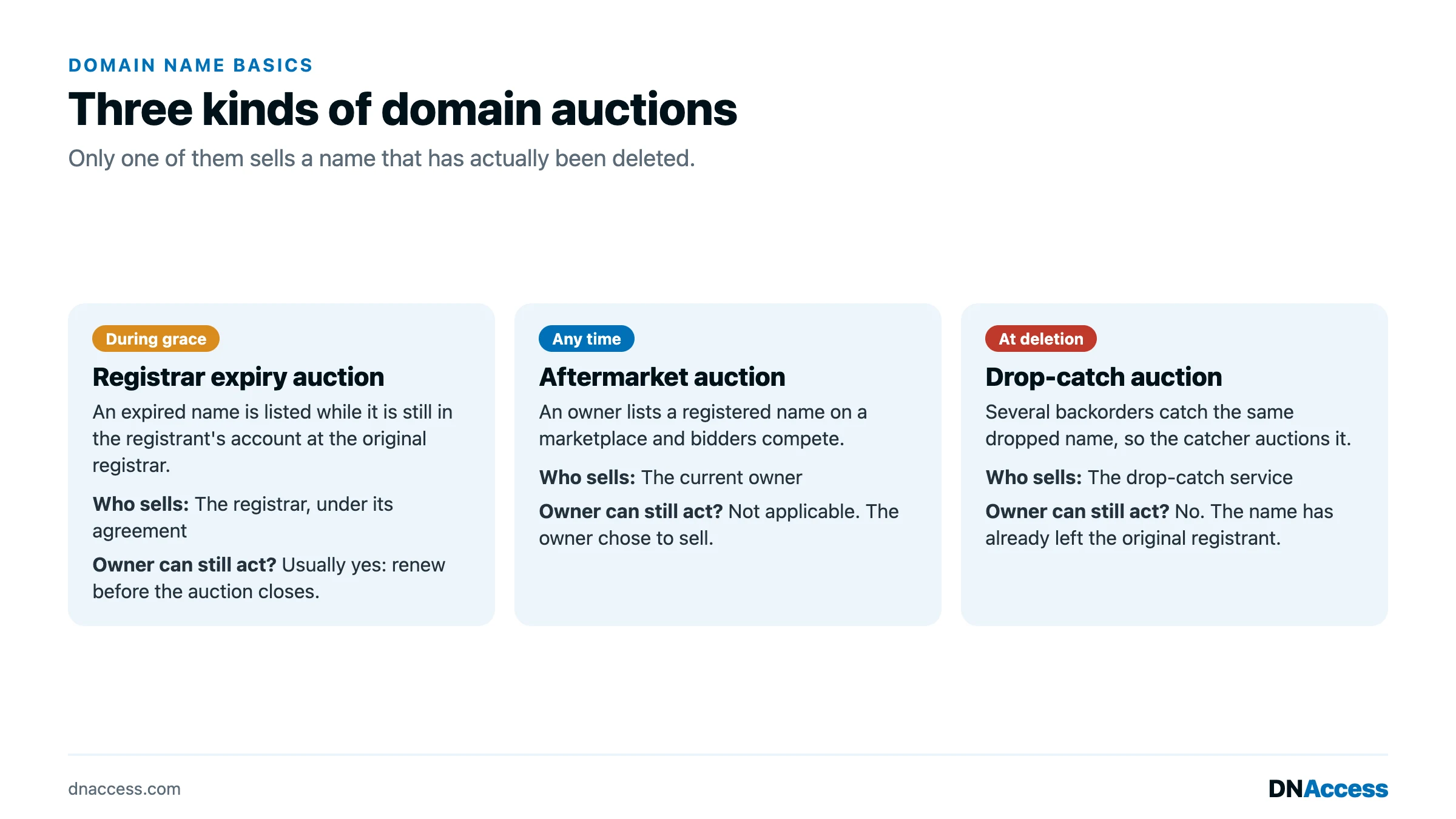
Every domain auction ends the same way, with a winning bidder and a transfer of the registration. What differs is where the domain comes from and what stage of its life it is in. The diagram below places the three kinds of auction against the life of a domain name.
Registrar expiry auctions
An expired domain auction run by a registrar sells a name that has passed its expiration date but has not been deleted. The domain is still sitting in the original registrant’s account, in the grace period after expiration, when the registrar lists it for bids. GoDaddy Auctions is the best-known example of this model: a large registrar offers expired names from its own customer base to bidders, and the winning bidder receives the domain once the grace period ends without a renewal. Other large registrars and their auction partners run similar programs, each under its own published terms.
The key point for owners is that during most of this window the original registrant can still renew. If the owner renews before the auction closes, the auction is normally canceled and the domain stays with the owner. If the owner does nothing, the winning bidder takes the name. Our domain expiration lifecycle guide shows where this grace period sits relative to redemption and deletion.
Aftermarket and marketplace auctions
An aftermarket auction sells a domain that is fully active and owned by someone who has decided to sell it. The owner lists the name on a marketplace, sets a starting price and often a reserve, and bidders compete. Domain investors use these auctions to sell portfolio names, and businesses use them to acquire names that are already taken. If you want to sell rather than buy, our guide to how to sell a domain name on GoDaddy walks through one marketplace’s listing process, and our analysis of whether buying and selling domains is profitable covers the economics.
The aftermarket is large. The InterNetX and Sedo Global Domain Report 2020 counted more than 19 million domains listed for sale at Sedo and reported an average 2019 Sedo sale of $2,284 against a median of $577.22, with .com accounting for 57% of sales, according to the Global Domain Report 2020. Those are 2019 figures, but the shape still holds: a small number of very valuable names pull the average far above what a typical domain sells for.
Drop-catch auctions
A drop-catch auction sells a domain that was deleted by the registry and immediately re-registered by a drop-catching service, a company that operates many registrar accreditations so it can submit registration requests the moment a name is released. Buyers place a domain backorder with the service in advance. If one person backordered the name, that person usually receives it. If several did, the service holds a private auction among the backorder holders.
This market is concentrated. In a 2016 measurement, DropCatch.com led .com drop-day re-registrations with 87,437 and SnapNames.com followed with 40,552, and drop-catch services controlled over 75% of accredited registrars, according to Lauinger et al., WHOIS Lost in Translation (USENIX Security 2017). It is also a serious business for the buyers: researchers studying 2017 drop-catching found that one professional invested at least $115,000 in three months, according to Miramirkhani et al., Panning for gold.com (WWW 2018).
How bidding, reserves and escrow generally work
Most domain auctions run for a fixed number of days. Bidders enter a maximum amount and the platform bids on their behalf in set increments, a method called proxy bidding. Many platforms extend the closing time by a few minutes whenever a bid arrives near the end, which prevents last-second sniping and lets competing bidders respond.
A reserve is a hidden minimum price set by the seller. If bidding does not reach the reserve, the auction ends without a sale, although the seller and the high bidder may still negotiate. Expiry and drop-catch auctions usually have no reserve, because the platform rather than an individual owner is the seller.
Payment and transfer are handled in one of two ways. On registrar and drop-catch platforms, the platform already controls the domain, so it collects payment and moves the name into the winner’s account directly. On marketplace auctions between private parties, the sale is usually closed through escrow, a neutral service that holds the buyer’s payment until the domain has been transferred to the buyer and then releases the funds to the seller. Escrow protects both sides from the most common aftermarket fraud: a buyer who never pays, or a seller who never delivers.
How an owner loses a domain to an expired domain auction
Many owners believe a domain is safe until it drops, the moment the registry deletes it and makes it available to the public. That belief is wrong at registrars that run expiry auctions. A domain can be auctioned and awarded to a new holder while it is still in the grace period, without ever being deleted, without ever entering the public drop, and without a backorder service being involved at all.
From the owner’s side, the sequence is quiet. Auto-renew fails because a card has expired. The renewal notices go to an old email address. The website stops resolving, but nobody connects the outage to the registration. Meanwhile, the name is listed, bid on and sold. When the owner finally logs in, the domain is gone, and the public record shows a new registrant. This is the point at which many of the expired domain cases we handle begin. The registrar has usually followed its published terms; the loss came from a missed renewal, not from wrongdoing.
The deliberate lesson, repeated here because it matters most: an expired domain auction can close while you still believe you have weeks left. Our guide to how domain renewal works explains how to keep a name from reaching this stage.
What to do if your expired domain is listed in an auction
If you find your own domain listed in an expiry auction, act immediately. First, log in to the registrar account where the domain is registered and renew it. If the auction has not closed, renewal at the current registrar normally removes it from the auction. Do not try to transfer the domain to another registrar; an expired domain generally cannot be transferred until it has been renewed. If the domain has already moved into redemption, request a restore from the same registrar, which costs more but still returns the name to you.
Second, if you cannot log in, contact the registrar’s support team, explain that you are the registrant of record and that the domain is in an active auction, and ask them to place a hold while you recover access. Do not bid on your own domain unless you have been told that renewal is no longer possible. If the auction has already closed and the name has moved to a new holder, the options change, and our guide to a domain re-registered by someone else explains what comes next.
Buying at a domain name auction safely
An auctioned domain arrives with its entire history. Before you bid, find out what it was used for. A name that once hosted malware, spam or adult content may be blocklisted by email providers and security filters, and a name that resembles a well-known brand may expose you to a trademark complaint. Previously malicious domains were caught about twice as often as benign ones in the 2017 drop-catch study cited above, which is a reminder that the buyers of expired names include people looking for a ready-made reputation to abuse.
Check the domain’s archived website content, its registration history and its standing on reputation lists. Our guide to domain history red flags lists the warning signs we look for. For a significant purchase, close the deal through escrow, confirm that the platform controls the name before you pay, and change the account credentials and contact details as soon as the domain arrives in your account.
Three auction mistakes we see in recoveries
In the cases we handle, auction losses trace back to the same few errors. The first is assuming that an expired domain is safe until it drops, when an expiry auction can award it to a bidder weeks earlier. The second is leaving renewal notices pointed at an address on the expiring domain, so that the outage that should have triggered action also silences every warning. The third is bidding on, or trying to transfer, a domain that could simply have been renewed at the original registrar.
How DNAccess helps when a domain goes to auction
DNAccess recovers domains that were lost to expiry auctions, drop-catch services and later resale. Our expired domain name recovery service works with the registrar while a domain is still renewable or redeemable, and with the new holder when it is not. We also run background checks on domains before clients bid. If your domain is listed in an auction right now, or has just been sold, contact us without delay.