A domain name is worth what a qualified buyer will pay for it, and for most registered names that figure is close to nothing. A small share of names, mostly short .com names built on common words with obvious commercial meaning, sell for thousands of dollars, and a handful sell for millions. A domain appraisal (an estimate of the price a domain name would bring in an open sale) tries to predict where a particular name falls on that range. An appraisal is a reasonable starting point. It is not a valuation you should rely on by itself, and the reasons why matter whether you are buying a name, selling one, or trying to recover one that was taken from you.
This guide, part of our domain name basics series, covers what drives value, where appraisal tools fail, what the aftermarket (the resale market for names already registered to someone) has paid, and why value becomes a legal question.
What drives domain name value
No single feature sets a domain’s price. Value comes from several factors stacking together, and a weakness in one can erase the strength of the others.
Length and simplicity
Shorter names are scarcer, easier to remember and easier to type, so they command higher prices. A name you can spell after hearing it once is worth more than one that needs explaining. Two-, three- and four-character .com names form a market of their own because every combination has long been registered.
Dictionary words and commercial intent
A name made of one or two common English words is easier to market than an invented string, and it is worth the most when those words describe something people pay for. Commercial intent (the likelihood that someone searching a term wants to buy something) is why a name describing an insurance product, a legal service or a consumer category outsells a name describing an abstract idea. Advertisers pay more for those terms, and buyers price that in.
The extension, and why .com still leads
The extension, or top-level domain (the part after the final dot, such as .com, .net or .ai), has a large effect on price. In the most recent downloadable edition of the Sedo and InterNetX market study, .com accounted for 57% of all aftermarket sales, according to the Global Domain Report 2020. A name that is strong in .com may be worth a small fraction of that in another extension, unless the extension itself carries meaning for the buyer’s industry.
Type-in traffic, history and backlinks
Type-in traffic is the stream of visitors who reach a domain by typing it directly into a browser. Backlinks are links from other websites that point to the domain. Both are inherited from the name’s past use, and both can carry real value. When researchers re-registered 201 expired domains for about $7.29 each, they received 650,737,621 requests from 5,540,379 unique IP addresses in four months, and at least 50.58% of the web clients were classified as residual-trust traffic, according to Squarcina and colleagues (IEEE Symposium on Security and Privacy, 2022). The same study found that 20.9% of those domains had previously hosted real-money gambling and 16.42% were crime-related. History cuts both ways. The traffic that raises a name’s value can arrive with a reputation that lowers it.
Brandability
Brandability is the quality that lets a name work as a company or product name: pronounceable, distinctive and free of awkward meanings. Invented words often score poorly on appraisal tools yet sell well to founders.
Trademark risk
A domain that matches or closely resembles someone else’s trademark has little lawful resale value, however short or memorable it is. The trademark owner can bring a complaint under the UDRP (Uniform Domain-Name Dispute-Resolution Policy) or sue under federal law, and a buyer who pays for such a name may simply lose it. Automated tools cannot measure this risk.
How automated domain appraisals work, and why they are rough
Automated appraisal tools model comparable sales. They take the features of a name, such as its length, the words it contains, its extension, the search volume of those words and the advertising cost per click (the price advertisers pay each time someone clicks an ad for the term), and compare them with names that sold in the past.
That method has two built-in weaknesses. The first is thin data. Most domain sales are private and never reported, so the model learns from a partial picture. The second weakness is more serious. An appraisal tool sees the name as a string of characters. It cannot see a trademark conflict, a history of spam or malware, a search penalty, an entry on a blocklist, or a chain of ownership that includes a theft. A name can appraise at a healthy figure and still be unsellable, or worse, recoverable by its rightful owner after you pay for it.
Treat a domain appraisal as a rough range that frames a conversation, not as a defensible valuation.
Comparable sales and what the aftermarket actually pays
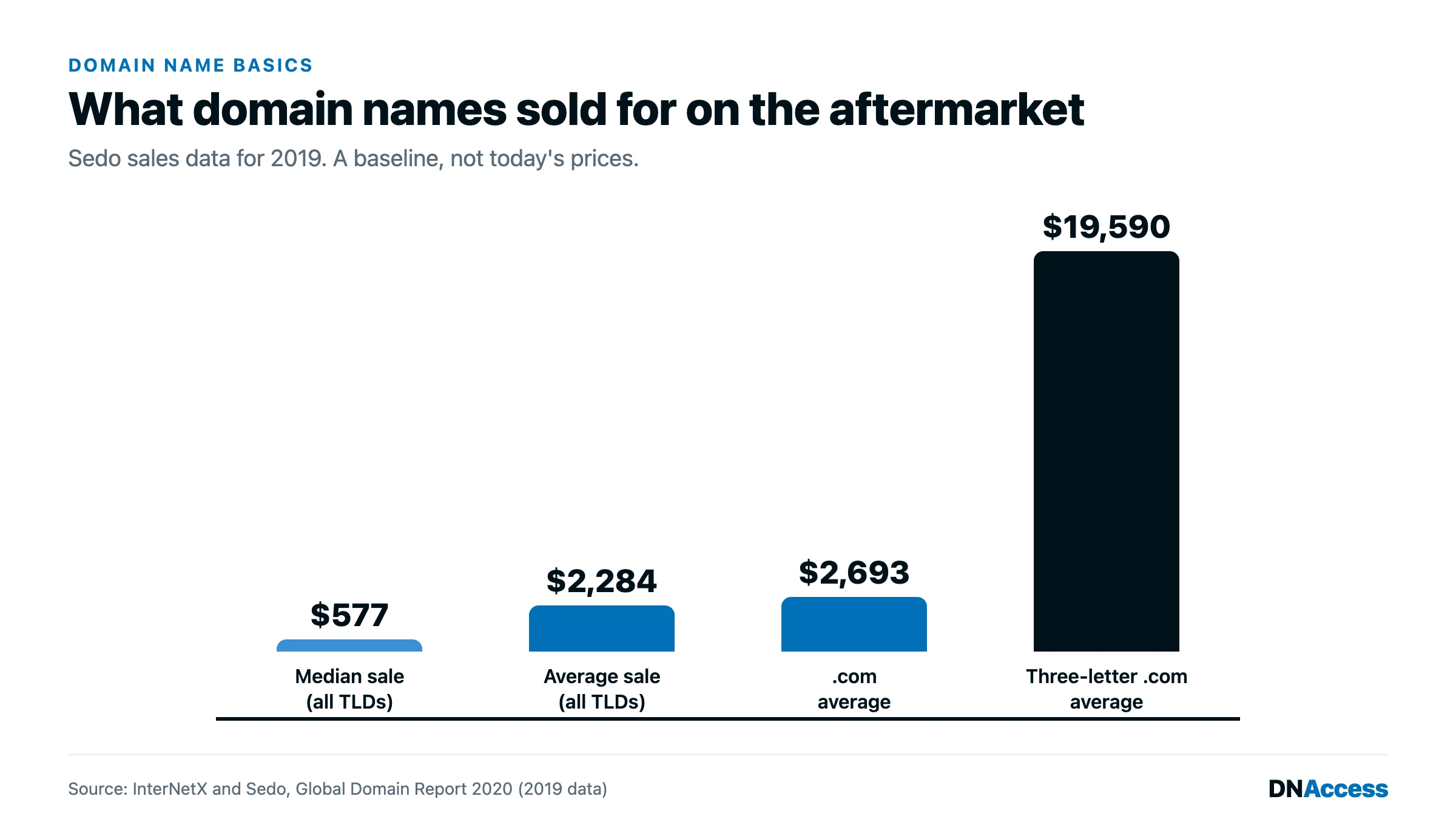
Published sales data is the best check on any appraisal, with one caveat: the most detailed downloadable figures are dated. The Global Domain Report 2020 from InterNetX and Sedo reported, for 2019, an average Sedo sale of $2,284 and a median of $577.22, with .com names averaging $2,693 at a median of $630. Three-letter .com names averaged $19,590 with a median of $5,000, and the highest reported 2019 sale was Voice.com at $30,000,000, according to the same 2019 report. More than 19 million domains were listed for sale at Sedo at the time.
The gap between the average and the median is the most useful lesson in those numbers. A few very large sales pull the average up, while the median, the price in the middle of all sales, shows what a typical name that actually sold brought. And with millions of names listed, most listings never sell at all. Because these are 2019 figures, treat them as a historical baseline, not a current price list.
Our articles on whether buying and selling domains is profitable and how to market domain names cover the investing side.
Registry premium pricing versus aftermarket premium names
The phrase “premium domain” means two different things, and confusing them is one of the more expensive mistakes a new owner can make. A registry premium name is one the registry operator (the company that runs an extension, such as Verisign for .com) has reserved and priced above the standard fee. An aftermarket premium name is one that a private owner or investor already holds and offers for resale.
| Question | Registry premium name | Aftermarket premium name |
|---|---|---|
| Who sets the price | The registry operator, through the registrar | The current owner, often through a marketplace or broker |
| What you pay up front | A higher registration fee | A one-time purchase price, then a transfer |
| What renewal costs | Often the same elevated premium fee every year | Usually the registrar’s standard renewal fee |
The renewal cost trap is the point to remember. Many registry premium names in newer extensions renew at the premium rate, not the standard rate, so a name that looked affordable in year one costs the same high amount every year after. Owners who did not read the renewal terms let the name lapse, and in the cases we handle, a lapsed premium name is often caught by someone else within days. Before you register any name marked “premium,” confirm the renewal price in writing and read our guide to domain renewal.
Why domain value matters in recovery and litigation
Value is not only a sales question. When a domain is stolen, lost or disputed, its value frames the damages claim, the settlement range and sometimes the choice of legal remedy. Courts treat a domain name as property. In Kremen v. Network Solutions (9th Cir. 2003), the Ninth Circuit held that a registrant has “an intangible property right in his domain name” and described the award against the man who took sex.com as $40 million in compensatory and $25 million in punitive damages, according to the court’s published opinion, 337 F.3d 1024.
Most disputes involve far smaller sums, but the question is the same: what was this name worth, and what did losing it cost? Answering that requires comparable sales, traffic records and the name’s history, explained in a way that holds up under cross-examination. An appraisal printout does not meet that standard. I have served as an expert witness in domain and internet marketing litigation, and our domain name expert witness page explains how valuation opinions are prepared for counsel.
Value also explains which names thieves take. The stolen names we see most often are short, old .com names, precisely what the aftermarket prizes and easy to resell to a buyer who never checks.
How a background check protects domain value
A domain’s price reflects its future, but its value depends on its past. A background check (a review of a name’s registration history, past content, DNS records, reputation and legal exposure) is how a buyer confirms the past supports the price. It shows whether the name was dropped and re-registered, whether it hosted spam or gambling, whether ownership changed suddenly before the sale, and whether a trademark owner is likely to object. Our guide to domain history red flags lists the warning signs.
For sellers, a documented clean history supports a higher price. Buyers should also read our guide to buying a domain that is taken.
Mistakes that turn into recovery cases
In the cases we handle, three valuation mistakes come up again and again. The first is treating an automated appraisal as a price and paying it without a history check, only to learn the name was stolen or carries a trademark problem. The second is registering a registry premium name without reading the renewal terms, then losing it when the second-year bill arrives. The third is underestimating what an owned name is worth and protecting it accordingly: a valuable domain left in a weak registrar account, without multi-factor authentication or a registry lock (a registry-level hold that blocks changes until the registrar verifies the request out of band), is an attractive target. Each of these mistakes starts as a question of value and ends as a question of recovery.
How DNAccess helps with domain name value
Our domain name background check examines a name’s registration and ownership history, past content, reputation and trademark exposure so that a buyer knows what the appraisal cannot show. For attorneys and parties in a dispute, we prepare valuation analysis and expert testimony grounded in comparable sales and the name’s documented history. Fees depend on the scope of the review, so contact us for a quote.