A domain name is the address people type to reach a website or send an email, and it is also an asset that can be registered, bought, sold, lost, stolen, and recovered. Most of the problems our clients bring us trace back to a gap in the fundamentals: who controls the name, what the registrar does, how DNS resolves, and what happens when a registration expires. This hub explains how domain names work from first principles and connects each topic to the detailed guides we have published on DNAccess.
What a domain name is and how it resolves
A domain name is a human-readable label, such as dnaccess.com, that stands in for the numeric IP address (Internet Protocol address, the number that identifies a server on the internet) where a website or mail server lives. The name itself is a record in a registry database, and the right to use it belongs to the registrant for the term of the registration.
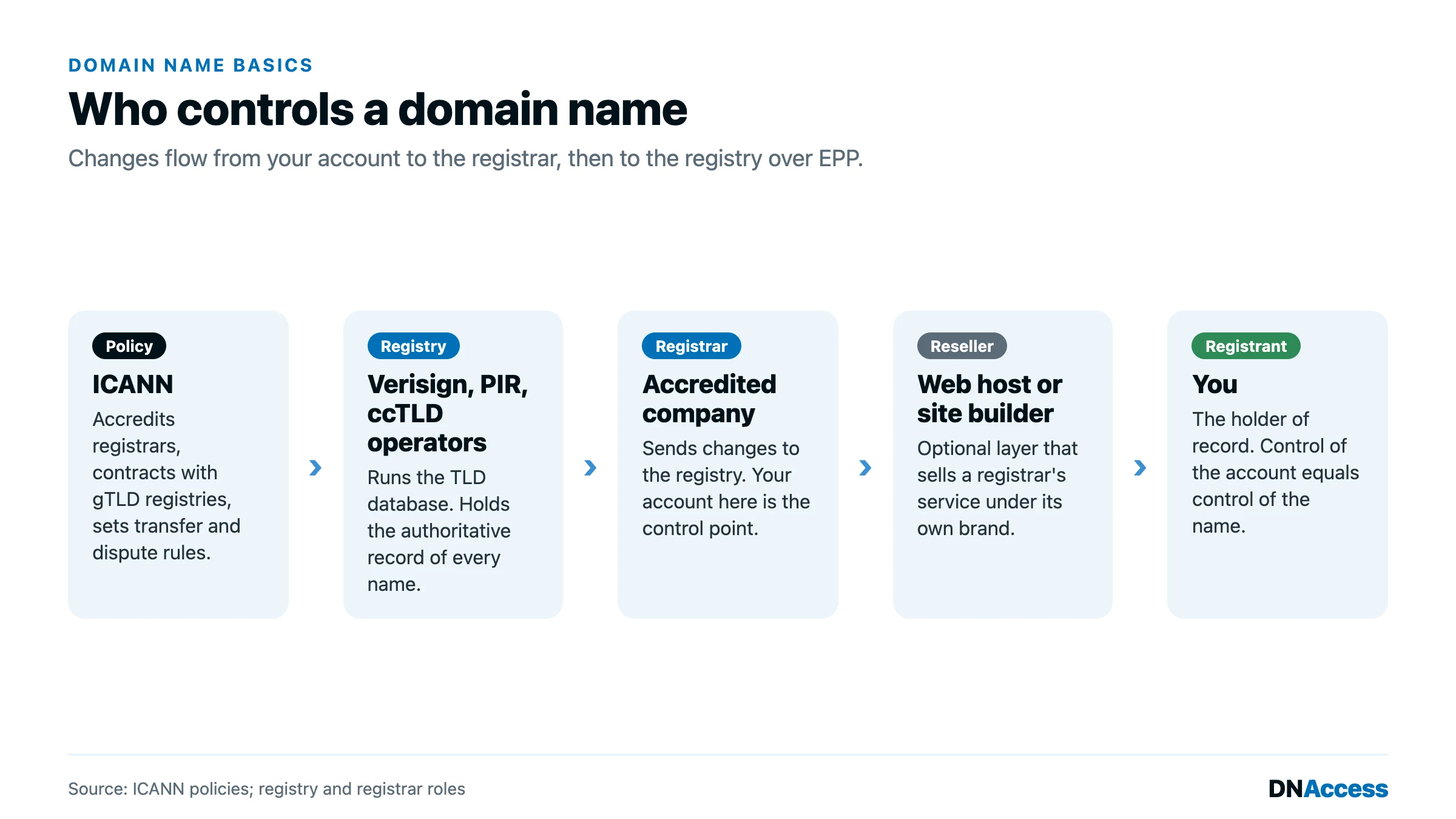
Three parties sit behind every registration. The registry operates the top-level domain (TLD, the part after the final dot, such as .com, .org, or .ai) and maintains the authoritative database of every name under it. The registrar is the ICANN-accredited company that sells registrations to the public and submits changes to the registry on the registrant’s behalf. The registrant is the person or organization that holds the registration. When you change a setting in your registrar account, the registrar relays that change to the registry, which is why control of the registrar account is, in practical terms, control of the domain name. Our guide to how domain name registrars work walks through that relationship in detail.
Resolution is handled by DNS (the Domain Name System, the distributed directory that maps names to addresses). Each domain delegates authority to a set of nameservers, which answer queries about its records: the A record that points the website to an IP address, the MX record that routes email, and so on. When a browser requests a page, a resolver walks from the root servers to the TLD servers to the domain’s own nameservers and returns the answer in milliseconds. We explain the lookup chain step by step in how DNS translates domain names into IP addresses, and the companion piece on how email domains work covers the mail side, where MX and authentication records decide whether messages from your domain are delivered.
There were 386.9 million domain name registrations across all top-level domains at the end of the fourth quarter of 2025, including 161.0 million .com names and 145.6 million country-code names, according to the Verisign Domain Name Industry Brief press release. Every one of those names depends on the same registry, registrar, and DNS arrangement.
Choosing a domain name and checking availability
Because registrations are exclusive, the first question for any new name is whether it is already taken. A registrar’s search box answers that, but it is not always the most informative option. We compared the main websites to check domain name availability, including WHOIS-based tools that also show when a name expires and who the registrar is. For the creative side of the search, our roundup of the best tools to find a domain name covers generators and the aftermarket searches that surface names already registered but listed for sale.
A custom domain name, meaning one you register and control rather than a subdomain of a hosting platform, is the foundation of a brand’s online identity. Our guide on how to get a custom domain name explains the choice between a .com, a country-code TLD, and a newer generic TLD, and why the exact-match .com still carries the most weight.
Registering a domain name
Registering a domain is a purchase of a term of exclusive use, not a purchase of the name in perpetuity. We address that distinction in what it means to purchase a domain name: you are paying the registrar for a registration period of one to ten years, and the registration must be renewed before it expires or the name returns to the pool. The mechanics of the transaction, from account creation to the initial DNS setup, are laid out in how buying domain names works.
Registrars and cost
Accredited registrars compete on price, support, and security features, from retail brands that sell millions of names to corporate registrars that serve enterprise clients. Our list of the top domain name registrars compares the major providers, and the broader survey of companies that sell domain names covers resellers, hosting companies, and marketplaces.
Pricing varies by TLD and registrar. Every registrar pays the registry’s wholesale fee for each name, and ICANN’s fee approval request for fiscal year 2027 sets a registrar transaction fee of USD 0.20 per transaction-year on top of that, according to the ICANN Registrar Fee Approval Request for FY27. The rest of the price is the registrar’s margin, which is why first-year promotional rates are often followed by much higher renewals. We break down the components in how much domain name registration costs.
WHOIS, RDAP, and privacy
Every registration creates a public record. WHOIS (the public registration record for a domain name) historically listed the registrant’s contact details along with the registrar, creation date, expiration date, and nameservers. Our explainer on what WHOIS is in domain name registration covers what the record contains and how it is used. ICANN set 28 January 2025 as the WHOIS Services Sunset Date for registrar obligations to provide registration data over port-43 and web-based WHOIS, according to the ICANN reminder on the effective date of the 2013 RAA Global Amendment. The replacement is RDAP (the Registration Data Access Protocol, a structured successor to WHOIS that supports authenticated, tiered access to contact data).
Since 2018, most registrant contact data has been redacted in the public record whether or not the registrant pays for privacy. Our guide on whether private registration is necessary for domain names explains what privacy still does and why accurate contact data behind the privacy layer matters for recovery if the account is ever compromised.
The aftermarket: buying and selling domain names
An aftermarket domain is one that is already registered and is being resold by its current registrant rather than registered fresh at a registrar. The aftermarket exists because the most memorable names were registered long ago, and because a short, generic, or brandable name is worth far more than its renewal fee to the right buyer. The InterNetX and Sedo Global Domain Report 2020 recorded an average Sedo sale of $2,284 and a median of $577.22 for 2019, with three-letter .com names averaging $19,590, and the highest reported sale that year was Voice.com at $30,000,000, according to the Global Domain Report 2020. Those are 2019 figures, but the spread they describe, a modest median and a long tail, still characterizes the market.
Is it legal, and is it profitable?
Registering a domain and selling it to someone else is legal. What is not legal is registering a name that is confusingly similar to someone else’s trademark with a bad-faith intent to profit from it, which is cybersquatting. Our guide on whether selling domains is legal draws that line clearly, and it matters, because a domain investor who crosses it can lose the name through a UDRP (Uniform Domain-Name Dispute-Resolution Policy) proceeding or face statutory damages in court.
Profitability is a harder question. Most registered names never sell, and carrying costs accumulate. We give an honest assessment in whether buying and selling domains is profitable, and we cover the practical work of finding buyers, pricing, and outreach in how to market domain names.
Selling on marketplaces
Most sales close through a marketplace or a registrar’s listing service, which handles the listing, the escrow, and the transfer to the buyer. The two most common starting points for a first-time seller are covered in our walkthroughs on how to sell a domain name on GoDaddy and how to sell a domain name on Google. In either case, confirm that the buyer’s funds have cleared escrow before the domain is pushed, because a transfer completed on a reversed payment is one way a name ends up in a dispute.
Keeping a domain name: renewal, expiration, and monitoring
A domain is kept by renewing it. That sounds simple, yet expired registrations account for a large share of our recovery work, usually because a renewal notice went to a departed employee’s inbox or an expired credit card. Our explainer on the domain name registration expiration date covers how to find it and what it means.
Expiration is a lifecycle, not a single event. Under ICANN’s Expired Registration Recovery Policy (ERRP), registrars must send two expiration notices, approximately one month and one week before expiration, and a further notice within five days after expiration if the name is neither renewed nor deleted; DNS resolution must be interrupted for at least the last eight consecutive days that the registration remains renewable, and gTLD registries must offer a 30-day Redemption Grace Period immediately following deletion, according to the ICANN ERRP policy text. After the redemption period the name enters pending delete and then drops, at which point drop-catching services register it within seconds. Our expired domain name recovery hub explains each stage and what can still be done at each one.
Domain monitoring means watching a domain’s registration, DNS, and status records for changes and alerting the owner when something moves. We define the discipline in what domain monitoring is, and for the opposite use case, waiting for a name you want to become available, we cover monitoring domain name availability. The domain monitoring hub brings the two together, including expiration monitoring for a portfolio and phishing-domain monitoring for a brand.
Domain name history and reputation
A domain name carries its past with it. Search engines, email filters, and security vendors keep records of what a name has done, and a name that previously hosted spam or malware can arrive with penalties that take months to shed. Before buying an aftermarket or dropped name, run a background check.
Two kinds of history matter. Registration history, assembled from archived WHOIS history records, shows who has held the name and when it changed hands. Our guide on domain name registration history explains how to read those records. DNS history shows where the name has pointed over time, which hosts and mail servers it used, and whether it was ever parked or redirected; we cover it in domain name DNS history. Both feed into the reputation question, which we address in how to check domain reputation, covering blocklists, sender reputation, and search engine signals. For a full investigation, see the domain name background check hub.
Protecting a domain name
The same facts that make a domain valuable make it a target. Because the registrar account controls the name, anyone who can log into that account, or reset its password through a compromised email address, can transfer the name away or change its DNS. Protection starts with the basics: a unique password, multi-factor authentication on both the registrar account and the email address it uses, registrar transfer locks, and, for names the business cannot afford to lose, a registry lock (a registry-level hold that blocks changes until the registrar verifies the request out of band). A registry lock works because the registry itself refuses to process a transfer or nameserver change, so even a fully compromised registrar account cannot move the name. Our domain name security best practices guide covers each control, and the domain security hub goes deeper into DNSSEC, typosquatting, lookalike domains, and registrar account security.
Legal protection runs alongside technical protection. A registered trademark gives the owner standing to bring a UDRP complaint against a cybersquatter and a claim under the Anticybersquatting Consumer Protection Act in U.S. courts. Our guide on how to trademark a domain name explains what can be registered and what a mark covers. Defensive registrations, domain blocking, and enforcement against impersonation are the subject of the online brand protection hub.
When prevention fails, the domain is either stolen or lost. Theft, meaning an unauthorized transfer or change of control, is addressed in the domain hijacking hub, which covers how hijacking happens, how to prevent it, and how recoveries have played out. Disputes over who has the better right to a name, as opposed to theft, are handled through the UDRP and the courts.
Domain name basics guides
Each guide below explains one part of how domain names work, in plain English, and the mistakes that most often turn into recovery cases.
What Is a Domain Name? How Domain Names Work, in Plain English
What a domain name is, how its parts and DNS work, what you actually buy, and the three mistakes that later turn into domain recovery cases.
Registrar vs. Registry: Who Actually Controls Your Domain Name
What a domain registrar and a domain registry each do, how changes flow between them over EPP, and why resellers can complicate a recovery.
Who Owns a Domain Name? Registrant, Account Holder, and Why It Matters
Who legally owns a domain name, how to find out who owns a domain today, and how to check and correct the registrant of record on your own names.
Top-Level Domains Explained: gTLDs, ccTLDs, and New Domain Extensions
What a top level domain is, how gTLDs, ccTLDs, new gTLDs, IDN and brand TLDs differ, and how to choose domain extensions for a business.
Nameservers and DNS Records Explained: A, CNAME, MX, and TXT
What nameservers do, where DNS records are edited, how A, CNAME, MX and TXT records work, and why hijackers change nameservers first.
How Domain Renewal Works: Terms, Auto-Renew, and What Happens If You Miss It
How domain renewal works: registration terms, renewal pricing, why auto-renew fails, ERRP notices, renewal scams, and what happens if you miss it.
Domain Status Codes Explained: clientTransferProhibited, clientHold, and More
What domain status codes mean, from clientTransferProhibited and clientHold to redemptionPeriod and pendingDelete, and what to do about each.
How Domain Transfers Work: Auth Codes, Transfer Locks, and Changing Owners
How a domain transfer works: EPP auth codes, transfer locks, account pushes and change of owner, plus what to do if a transfer you did not request appears.
How Domain Auctions Work: Expiry Auctions, Aftermarket Auctions, and Drops
How domain name auctions work: registrar expiry auctions, aftermarket listings, drop-catch auctions, bidding, escrow and saving your expired domain.
What Is a Domain Backorder? Drop-Catching and Dropped Domains Explained
What a domain backorder is, how drop-catch services capture dropped domains in seconds, pending delete timing, and when a backorder is worth it.
What Is Domain Parking? How Parked Domains Make Money and When It Is a Warning Sign
What domain parking is, how parked domains earn ad revenue, the trademark risk of parking links, and why a parking page on your own domain is urgent.
How Much Is a Domain Name Worth? Domain Value, Appraisals, and Premium Names
What drives domain name value, why automated domain appraisals are rough, what the aftermarket pays, and how premium names and renewal costs differ.
How to Buy a Domain Name Someone Else Owns: Brokers, Escrow, and Safe Transfers
How to buy a domain someone else owns: find the owner, use a domain broker, check history for theft, close through domain escrow and secure the name.
Domain Name Glossary: 61 Terms Every Domain Owner Should Know
Plain-English definitions of the domain terms owners meet, from auth codes and registry lock to RDAP, UDRP, TURF and the redemption grace period.
More domain name guides
These guides cover registrars, the technology behind domain names, and the domain aftermarket in more depth.
Registrars and registration
How Domain Name Registrars Work
How registrars sit between you, the registry and ICANN, and what they actually control.
The Top Domain Name Registrars of 2026
A comparison of the largest registrars on renewal pricing, account security and transfer policies.
Companies that Sell Domain Names
The different kinds of companies that sell domain names, from accredited registrars to resellers and marketplaces.
Domain Name Registration Cost
What a domain costs to register and renew, and why the renewal price matters more than the first-year price.
How to Get a Custom Domain Name
Choosing, registering and connecting a custom domain name for a business website.
Best Tools to Find a Domain Name
Name generators and availability tools for finding a domain name that is still open.
How domain names work behind the scenes
How Does DNS Translate Domain Names?
How DNS turns a domain name into an IP address, step by step.
How Email Domains Work
How email on your own domain works, from MX records to SPF, DKIM and DMARC.
Buying, selling and investing in domain names
What Does Purchase a Domain Name Mean?
What you actually get when you “buy” a domain name, and what you do not.
How Does Buying Domain Names Work?
How buying a domain name works, from registration to buying one that is already taken.
Is Buying and Selling Domains Profitable?
Whether domain investing still pays, and the costs and risks most new investors underestimate.
Is Selling Domains Legal?
When selling domain names is lawful and when it crosses into cybersquatting.
How to Market Domain Names
Pricing, marketplaces and outreach for selling a domain name to an end user.
How to Sell a Domain Name on GoDaddy
Listing and selling a domain name through GoDaddy and Afternic.
How to Sell a Domain Name on Google
Selling a domain that was registered with Google Domains, now managed by Squarespace.
Domain name articles from the DNAccess blog
These articles from the DNAccess blog cover availability, registration records, domain history and protection in more detail.
Checking availability and registration records
Websites To Check Domain Name Availability
The tools and registrar sites that show whether a domain name is available, and what their results do and do not tell you.
Monitoring Domain Name Availability
How to watch a registered name you want so you know the moment it expires or becomes available.
What is Domain Name Registration Whois?
What WHOIS registration data contains, why most of it is now redacted, and how RDAP replaced it.
Is Private Registration for Domain Names Necessary?
What privacy and proxy services hide, what they cannot hide, and when private registration makes sense.
Domain Name Registration Expiration Date
How to find a domain name’s expiration date and what happens on and after that date.
Domain history and reputation
Domain Name Registration History
How to trace a domain name’s past owners and registrars before you buy it or rely on it.
Domain Name DNS History
How historical DNS records show where a domain pointed over time, and why that record matters in disputes.
How to Check Domain Reputation
How to check whether a domain name carries spam, malware or blocklist history.
How To Measure Brand Reputation
How to measure how a brand is perceived online, from search results to reviews and mentions.
Protecting a domain name
Domain Name Security Best Practices
The account, registrar and DNS controls that keep a domain name from being stolen.
What is Domain Monitoring?
What domain monitoring watches for and how alerts on registration and DNS changes work.
How To Trademark A Domain Name
When a domain name can be registered as a trademark and how trademark rights help in a domain dispute.
What DNAccess does
DNAccess works where the fundamentals above break down. We recover stolen domain names through registrar escalation, transfer dispute procedures, UDRP proceedings, and litigation support, and we have recovered hundreds of them. We recover expired and re-registered domains, run background checks on names our clients intend to buy, monitor portfolios and brands through DNShield, and manage registrations for organizations that would rather not be the single point of failure on their own names. If a domain name that matters to you is at risk, lost, or already gone, contact us and we will tell you what can be done.