Domain renewal is the act of paying to extend a domain name registration before its current term runs out. Nobody buys a domain name outright. You rent the right to use it for a fixed term, and when that term ends, the right ends with it unless you renew. That single fact explains everything that follows, from auto-renew failures to what happens if you miss a renewal.
Our domain name basics hub explains the parties involved; this page focuses on keeping the name you already have.
How domain renewal works: registration terms
When you register a domain, you choose a registration term, the length of time the registration lasts before it must be renewed. For generic top-level domains (gTLDs, extensions such as .com, .net and .org), ICANN rules allow terms of one to ten years. The registrar (the company that sells you the registration and manages it on your behalf) records the expiration date with the registry (the organization that operates the extension and keeps the master list of every name under it). Renewing simply moves that expiration date forward by the number of years you pay for, up to the same ten-year ceiling.
Renewal does not reset anything else. Your nameservers, email records, contact details and locks stay as they are. The only thing that changes is the date. That is why renewal is so easy to overlook: when it works, nothing visible happens, and when it fails, the first visible sign is often a website or email system that stops working.
Renewal pricing versus the first-year price
Many registrars sell the first year of a registration at a promotional discount and then bill renewals at a higher standard rate. The renewal price, not the first-year price, is the real cost of owning a domain over time. Premium names and some newer extensions renew well above the typical .com rate. Our guide to how much domain name registration costs breaks down the pricing models in detail. The practical point here is simple: check the renewal price before you register, because that is the number you will pay every year afterward.
Domain auto-renew and why it fails
Domain auto-renew is a registrar setting that charges the payment method on file and renews the domain automatically, usually some days or weeks before the expiration date. It is the single most useful protection against an accidental lapse, and you should turn it on for every domain you intend to keep. It is not, however, a guarantee. In the recoveries we handle, auto-renew was often enabled and still failed, for three common reasons.
First, the payment method expired or was replaced. A corporate card is reissued, a company changes banks, or the employee whose card was on file leaves. The renewal charge is declined, the registrar sends a notice, and the notice goes unread. Second, the renewal notices go to an old email address: a former employee, a web developer who no longer works with the business, or a personal account nobody checks. Third, and most damaging, the notices go to an address on the domain that is expiring. When the domain lapses and its email stops working, the warning that would have saved it can no longer be delivered. The account contact should always be an address on a different domain.
Auto-renew also stops quietly when an account is locked for an unpaid balance or belongs to a departed staff member. That is why domain expiration monitoring matters: it watches the expiration date in the public registration record, independently of whatever the registrar account believes is happening.
What your registrar must send under ERRP
ICANN’s Expired Registration Recovery Policy (ERRP, the consensus policy that sets minimum registrar obligations around expiration) requires a baseline of warnings for gTLD domains. Registrars must send two expiration notices, approximately one month and one week before expiration, and a further notice within five days after expiration if the name has been neither renewed nor deleted, according to the ICANN Expired Registration Recovery Policy redline of 21 February 2024. The same policy requires that DNS resolution be interrupted for at least the last eight consecutive days that the expired registration remains renewable, and that any landing page conspicuously indicate the registration is expired. Contracted parties had to implement the updated policy by 21 August 2025.
The interruption is deliberate. It is designed to make an expired domain impossible to ignore while it can still be renewed at the ordinary price. The weakness is that every one of these warnings depends on contact details being current. A registrar can fully comply with the ERRP and the owner can still never see a single notice.
What happens if you don’t renew your domain
If you miss a renewal, the domain does not vanish on the expiration date. It moves through a series of stages, each with less room to act and a higher price to fix. The diagram below shows the sequence.
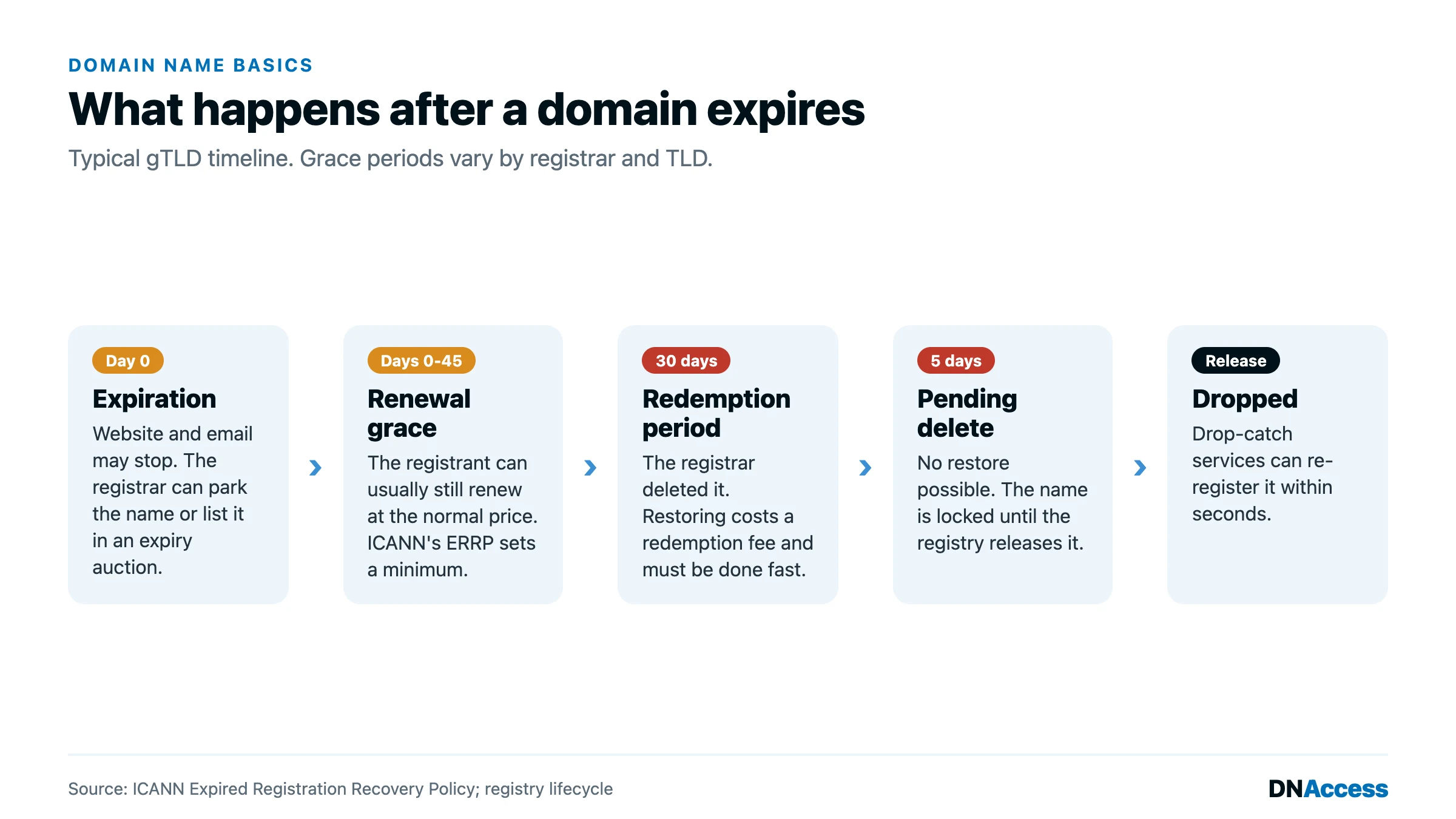
In brief, the domain first enters a grace period controlled by the registrar, during which you can usually renew at or near the standard price, although your website and email will stop resolving. Some registrars place expired names into an expiry auction during this window, as our guide to how domain auctions work explains. If the registrar deletes the name, it enters a 30-day Redemption Grace Period, during which only the original registrar can restore it, for a redemption fee that is commonly several times the renewal price. After that comes a five-day pending delete period in which nobody can act, and then the name is released to the public. Our domain expiration lifecycle guide covers each stage, its status code and its options in full.
Once a name is released, specialized services compete to register it within moments. A measurement of more than four million domains found that 10.1% of deleted .com domains are re-registered on the same day their old registration is deleted, according to Lauinger et al., WHOIS Lost in Translation (USENIX Security 2017). The lesson repeats throughout this guide: renewal is cheap before expiration and expensive, or impossible, after it.
Multi-year renewal strategy
For any domain that carries your website, your email or your brand, renew for multiple years at a time. A five- or ten-year term reduces the number of renewal events, and every renewal event is a chance for a card to fail or a notice to go astray. Multi-year renewal does not replace auto-renew; it works alongside it. Keep auto-renew on and hold a multi-year term on every core domain.
Organizations with many domains should keep a single inventory that lists each name, its registrar, its expiration date, the account owner and the payment method. Consolidating names at one or two registrars, under an account owned by the organization rather than an individual, removes most of the failure points described above.
Domain renewal scams and fake invoices
Because expiration dates and some contact details are visible in registration records, domain owners receive renewal offers that are not from their registrar. Some are fake invoices designed to look like a bill for an existing domain. Others are domain slamming (a practice in which a company uses an official-looking “renewal notice” to persuade an owner to transfer the domain to a different registrar, often at an inflated price).
The defense is straightforward. Renew only by logging in directly to the registrar you already use, never through a link or payment address in an unsolicited letter or email. If you are unsure which registrar holds a domain, look it up in the public registration record rather than trusting the notice. The same caution applies to messages that impersonate ICANN, which we describe in our write-up on fake ICANN verification emails.
Three domain renewal mistakes we see in recoveries
Most of the expired domains that reach DNAccess were not abandoned. They were lost through small administrative gaps that compound.
Registering the domain in one person’s name
The domain is registered in an employee’s or developer’s personal account, with their card and their email. When that person leaves, renewal stops and nobody inside the organization can log in to fix it. The domain belongs, in practical terms, to whoever controls the account.
Using the expiring domain for the renewal contact
The registrar sends every notice to an address on the domain itself. The renewal fails, the domain stops resolving, and every subsequent warning bounces. We see this pattern more than any other.
Waiting until the redemption period to act
Owners assume an expired domain can be renewed at any time, ignore the website outage, and act only when the name is in redemption or already deleted. At that point the cost rises sharply, and after the drop, recovery depends on who caught the name. Our guide to a domain re-registered by someone else explains the options at that stage.
How DNAccess helps with domain renewal and expired domains
DNAccess works on both sides of a renewal problem. Before anything goes wrong, DNShield domain name monitoring watches expiration dates, status changes and registration records across your portfolio and alerts you through channels that do not depend on the domain itself. When a renewal has already failed, our expired domain name recovery service works through the registrar, the redemption process or the current holder to get the name back. If a domain is approaching expiration or has already lapsed, contact us as early as possible, because every day narrows the options.