You can buy a domain name that someone else owns, but only if the owner agrees to sell it. The process has a predictable shape. First you confirm the name is registered and find out whether it is already listed for sale. Then you identify and contact the owner, directly or through a domain broker, and agree on a price. Before any money moves, you check the name’s history for theft, trademark and reputation problems. Finally, you close through domain escrow (a neutral third party that holds the buyer’s payment until the domain is delivered) and secure the name in your own account. Skipping the history check or the escrow step is where most buyers get hurt.
This guide is part of our domain name basics series. For a shorter overview of the mechanics, see our article on how buying domain names works, and for what you actually acquire when you pay for a name, read what it means to purchase a domain name.
Confirm the domain is taken and check whether it is for sale
A name that shows as unavailable at a registrar is registered to someone, but that does not mean it is in use or off the market. Visit the domain in a browser. Many owners point unused names at a for-sale lander (a simple page that announces the name is available and gives a price or an offer form). Others list names on aftermarket marketplaces such as Sedo or Afternic, where a listing may carry a fixed “buy now” price or invite offers. A listing is the easiest case, because the owner has already decided to sell.
Check the expiration date as well. If the registration is close to lapsing and the owner appears inactive, the name may reach a public drop or an expired-name auction instead. Our guide to domain auctions explains how expiring names are sold and what a backorder can and cannot do.
Find the owner
If the name is not listed, you need to reach the registrant (the person or organization that holds the registration). Start with an RDAP lookup. RDAP, the Registration Data Access Protocol, is the successor to WHOIS and returns the registrar, the key dates and whatever contact data the registrar publishes. For most names today, the registrant’s personal details are redacted or hidden behind a privacy service (a company that substitutes its own contact details for the owner’s). In that case, the record usually shows a relay email address or a web form that forwards messages to the owner. Some registrars also offer their own contact or brokerage forms for names under their management.
A website on the domain may list a business name or contact page, which is often the most direct route. Our guide to domain name ownership explains who the registrant legally is and why the name on the record matters.
Approach anonymously or in your own name
Who asks affects the price. An inquiry from a recognizable company signals budget and need, and owners often raise their asking price accordingly. An inquiry from an individual or an unfamiliar email address tends to draw a more modest number. Many established businesses make the first approach anonymously, through a personal address, a newly formed entity or a broker, for exactly this reason. Anonymity is lawful and common. Misrepresentation is not: do not make false statements about who you are or why you want the name.
When to use a domain broker
A domain broker is an intermediary who locates owners, opens negotiations and manages the sale, usually for a commission on the final price. A buyer’s broker represents you; a seller’s broker represents the owner and may also run the marketplace listing. A broker earns the fee in three situations: when the name is valuable enough that a few percentage points of negotiating skill pay for the commission, when you want to keep your identity confidential, and when the owner is hard to reach. For an inexpensive name with a published price, a broker adds little.
Negotiating the price
Ground your offer in comparable sales, not in what the name is worth to you. Published figures help set expectations. In the 2019 data reported in the InterNetX and Sedo Global Domain Report 2020, the median Sedo sale was $577.22 and the median .com sale was $630, while more than 19 million domains were listed for sale. Those are dated figures, but they show that most listed names sell for modest sums and that sellers have plenty of competition. Our guide to domain name value explains how appraisals and comparable sales work.
Open below your ceiling, leave room to move, and agree in writing on the price, the escrow service, who pays the escrow fee and how the domain will be delivered. Owners of names with no listing may decline any offer. That is their right.
Due diligence before any money moves
The domain you are buying has a past, and the past transfers with it. Before you pay, review the name’s registration history, its prior content in web archives, its DNS records, its reputation on blocklists and any trademark that matches it. A name that matches another company’s mark can be taken from you through a UDRP (Uniform Domain-Name Dispute-Resolution Policy) complaint after you have paid for it.
Watch for signs that the seller may not be the rightful owner. In the cases we handle, stolen domains often show a recent registrar change, a switch from public to private registration shortly before the sale, a price well below comparable sales, a seller who pushes for speed, and a request to pay outside escrow by wire or cryptocurrency. Any one of these deserves a pause. Several together are a warning. Our guide to domain history red flags describes what each signal means, and a domain name background check puts the full history in one report before you commit.
How domain escrow works
Domain escrow protects both sides by making sure neither has to trust the other. First, the buyer and seller agree on terms with a licensed escrow service and both accept the transaction. Then the buyer pays the escrow service, which holds the funds and confirms receipt to the seller. Once the seller is told the money is secured, the seller delivers the domain. Delivery takes one of two forms. A transfer moves the domain from the seller’s registrar to the buyer’s registrar using an authorization code (a password issued by the current registrar that releases the name), and it typically completes within five days. A push moves the domain between two accounts at the same registrar, which is faster and does not require an authorization code. After the buyer confirms that the domain is in the buyer’s account and under the buyer’s control, the escrow service releases the funds to the seller.
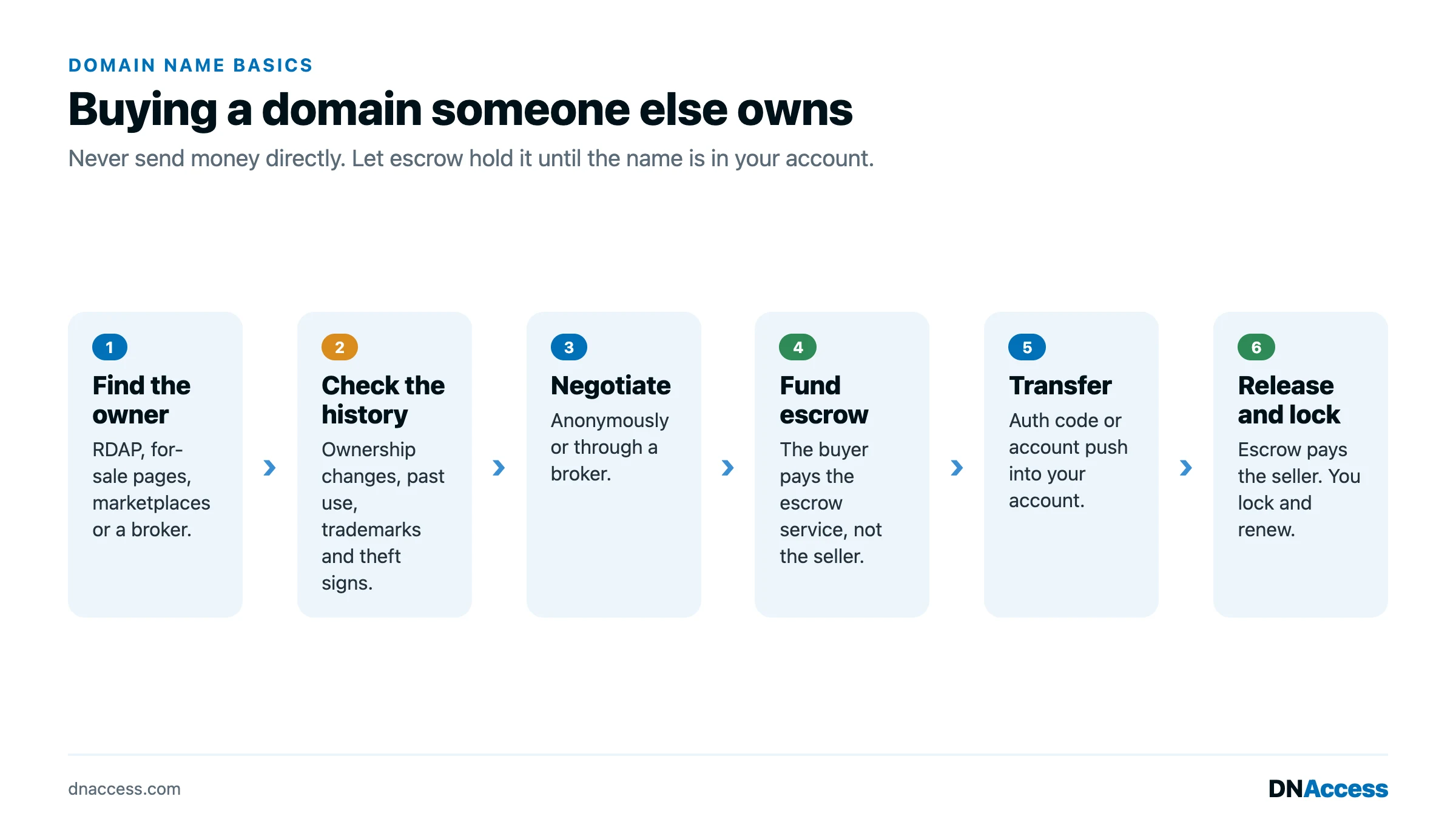
Two practical points follow from ICANN’s transfer policy. A domain that has just been registered or transferred is generally locked against another registrar transfer for 60 days, so a push or a transfer to the seller’s own registrar may be the only option at first. And a buyer should not confirm delivery until the registration record shows the new registrant. Our guide to domain transfers covers the steps in detail.
The stolen-domain risk for buyers
Buying a stolen domain does not make it yours. Courts treat domain names as property. In Kremen v. Network Solutions (9th Cir. 2003), the Ninth Circuit held that a registrant has “an intangible property right in his domain name,” according to the court’s published opinion, 337 F.3d 1024. That case arose from the theft of sex.com. A buyer who pays a thief can lose the domain to the original owner through a UDRP decision or a court order and be left to pursue the seller, who is often anonymous and overseas.
Thieves sell stolen names precisely because buyers rarely check. In the Patterns.com matter described in our case studies, the domain was taken from its owner’s registrar account and then offered for sale, and the UDRP panel cited that general offer to sell as evidence of bad faith before ordering the name returned. The same domain was later sold without its owner’s permission, so anyone acquiring Patterns.com today would be acquiring a stolen domain name. A background check and escrow are the buyer’s protection against becoming the last link in that chain.
After the purchase
Once the domain is in your account, secure it the same day. Turn on multi-factor authentication at the registrar, confirm the registrar lock is active, update the registrant contact to an address your organization controls, and renew the registration for several years, since terms of up to ten years are available. Keep the escrow records and purchase agreement with your corporate documents. They are your proof of ownership if anyone challenges it later.
How DNAccess helps buyers
DNAccess reviews domains before purchase so that buyers know what they are getting. Our domain name background check examines registration and ownership history, past content, reputation and trademark exposure, and flags the theft indicators described above. If a purchase goes wrong and a name you paid for turns out to be disputed, or a name you own is taken, our stolen domain name recovery service works to restore control. Contact us for a quote before you send payment.