A domain backorder is a request, placed in advance, for a service to try to register a domain name the moment it becomes available. You cannot register a name that someone else holds, but you can stand in line for it. If the current registration is allowed to expire and is eventually deleted, the backorder service attempts to capture the name for you at the instant of deletion. That moment is called the drop, and names released this way are known as dropped domains.
This guide, part of our domain name basics series, explains what a backorder actually buys, how drop-catching works, and why a backorder is rarely the right tool for an owner trying to save a domain they have just lost.
What is a domain backorder?
A backorder is a reservation of effort, not a reservation of the name. When you place one, the service agrees to attempt a registration on your behalf when the domain is released. You usually pay only if the attempt succeeds. Nothing about the backorder affects the current owner, who remains free to renew at any point before deletion. If the owner renews, the backorder simply never fires.
That distinction matters. A backorder does not give you any rights in the domain, does not notify the owner, and does not shorten the expiration process. It only positions you to act at the end of that process, if the process ever reaches its end.
Pending delete timing and the drop
A domain that expires and is not renewed moves through a fixed sequence before it can be backordered successfully. After the registrar’s grace period, the registrar deletes the name, and the registry places it in a 30-day Redemption Grace Period (a hold during which only the original registrar can restore it for the former owner). If nobody restores it, the name moves to pendingDelete, a five-day status during which no one can renew, restore or register it. At the end of those five days, the registry deletes the name and it becomes available. The diagram below shows where pending delete sits in the full sequence.
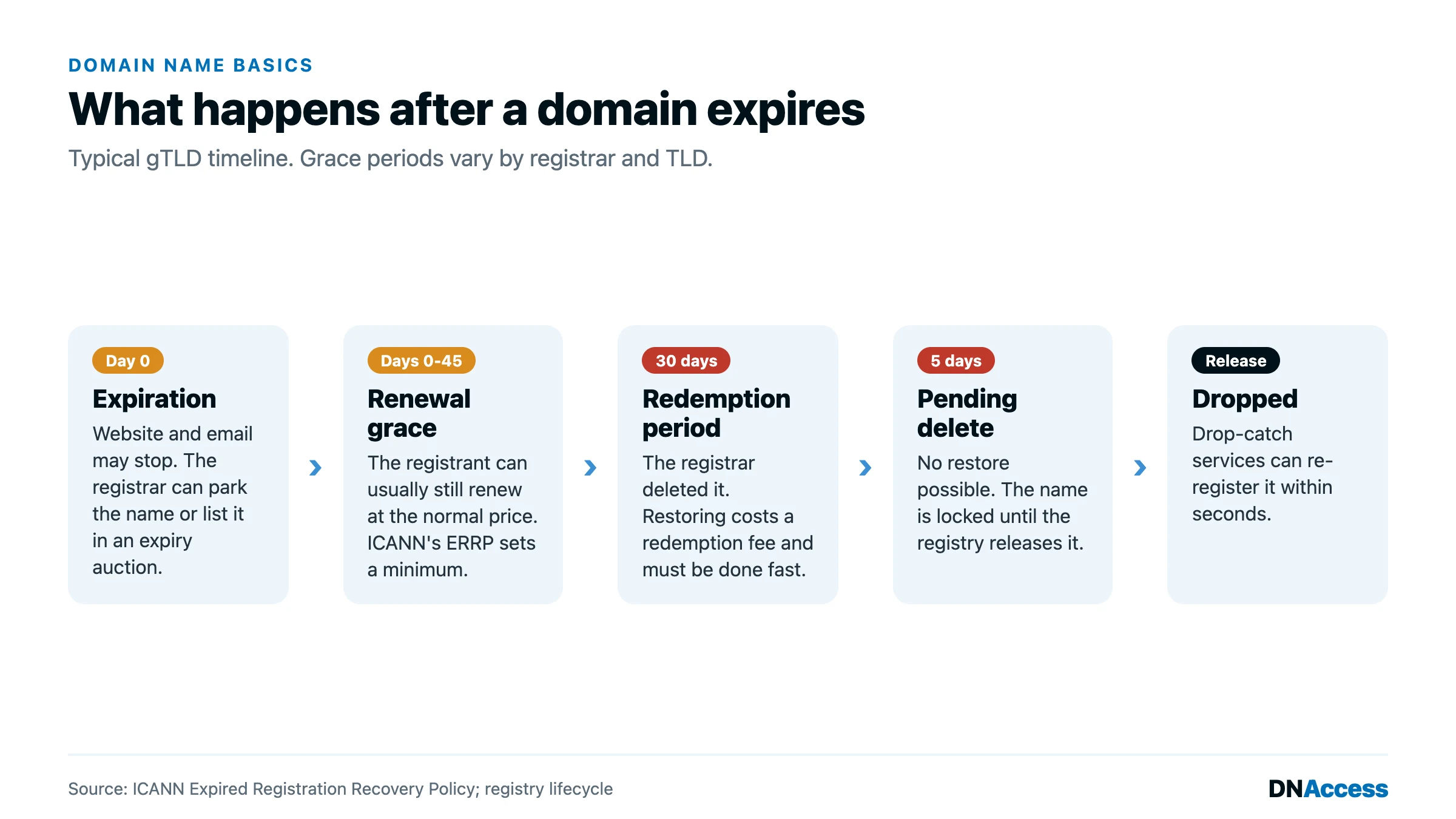
A pending delete domain is therefore a name whose drop date is predictable. Lists of pending delete domains are published by drop-catch services and data providers, and that predictability is what makes the drop-catch market possible. Our domain expiration lifecycle guide covers each earlier stage in detail.
How drop-catch services work at the moment of deletion
When a registry deletes a batch of names, any accredited registrar may submit a request to register them. Requests are handled on a first-come basis, and each registrar has a limited number of connections to the registry. Drop-catch services, companies built for this single purpose, respond to that rule by operating many registrar accreditations at once, so they can send far more requests at the moment of release than an ordinary registrar can.
The speed involved is difficult to overstate. A four-week 2016 measurement of more than four million domains found that 10.1% of deleted .com domains are re-registered on the same day their old registration is deleted, that drop-catch services control over 75% of accredited registrars, and that over half of .org drop-day re-registrations occur within the first 30 seconds, according to Lauinger et al., WHOIS Lost in Translation (USENIX Security 2017). Thirty seconds. By the time a person notices a domain has dropped, a desirable name is usually already registered to someone else.
Multiple backorders lead to an auction
If only one customer has backordered a name and the service catches it, that customer usually receives it at the stated backorder price. If several customers backordered the same name with the same service, the service holds a private auction among them, and the highest bidder wins. Because the most valuable dropped domains attract many backorders, the backorder fee is often only the entry ticket to a domain name auction where the final price is far higher.
Registrar backorders versus drop-catch services
Backorders are sold by two kinds of provider. Some retail registrars offer backorders to their customers, and a few of them also run expiry auctions on names in their own customers’ accounts. Dedicated drop-catch services, by contrast, operate large networks of registrar accreditations and compete at the moment of deletion. A registrar backorder can be effective when the domain is registered at that same registrar, because the registrar may move the expiring name to its own auction before deletion. For a name at another registrar that goes all the way to the drop, the services with the most connections usually win.
Placing backorders with more than one service increases the chance of capture, but it also means you may face a separate auction at whichever service succeeds.
Who catches dropped domains
Most dropped domains are never caught at all. Researchers who monitored 28,401,974 pending delete .com, .net and .org names over nine months in 2017 found that only about 10% were caught, that dropcatchers representing 0.03% of registrant clusters registered 60% of them, and that previously malicious domains were caught about twice as often as benign ones, according to Miramirkhani et al., Panning for gold.com (WWW 2018).
The pattern is clear. A small group of professionals catches the names that have value, and value includes leftover traffic, backlinks and email. A business domain with years of history is exactly the kind of name this group targets. For anyone who simply watches for a name to become free, our guide to monitoring domain name availability explains how to track a domain without a paid backorder.
When a domain backorder is worth it
A backorder makes sense in two situations. The first is a name you want that belongs to someone else and appears to be lapsing: the website is gone, the record shows an expiration date that has passed, and the owner shows no sign of renewing. A backorder costs little and positions you if the name drops. The second is your own lapsed domain once it has passed beyond the point where you can restore it, typically after the Redemption Grace Period ends and the name is in pending delete. At that stage, a backorder with several drop-catch services is the only move left before the drop.
Why the original owner rarely wins without acting earlier
An owner who waits for the drop is competing against professionals with more registrar connections, more capital and every incentive to want the name. The original owner has no priority at the drop. Worse, an established domain attracts multiple backorders, so even a successful capture often ends in an auction against investors who know what the traffic is worth.
The owner’s real advantage exists only earlier in the lifecycle. During the grace period, the owner can renew. During the Redemption Grace Period, the owner can restore. Both options belong to the owner alone and do not depend on speed. Once the name reaches pending delete, that advantage is gone. We repeat it because it is the core lesson of this page: a backorder is the last resort for an owner, never the plan.
Three backorder mistakes we see in recoveries
In the cases we handle, three errors recur. Owners place a backorder on their own expired domain while it is still in redemption, instead of simply restoring it through the registrar. Owners place a single backorder with one service and assume it guarantees the name. And owners who do lose the name at the drop wait weeks before investigating who caught it, when early contact with the new holder usually costs less. If your domain has already been caught, our guide to a domain re-registered by someone else explains the options.
How DNAccess helps with dropped and backordered domains
Our expired domain name recovery service intervenes at whichever stage a domain has reached: renewal or restoration through the registrar, coordinated backorders across drop-catch services when the name is in pending delete, and negotiation with the new holder when it has already been caught. If you are watching a domain approach the drop, contact us before it reaches pending delete, while the options are still yours.