The owner of a domain name, in the sense that matters legally, is the registrant of record: the person or organization named as the registrant in the registration data held by the registrar and the registry. That is not always the person who paid for the name, the person who manages it, or the person who holds the registrar login. When those roles drift apart, the business that thinks it owns its domain can discover, at the worst possible moment, that someone else is listed as the holder.
This guide is part of our domain name basics section. It explains who owns a domain name, how to find out who owns a domain today, how to check and correct the ownership of your own names, and why “owning” a domain always means holding a renewable right rather than a permanent title.
The registrant of record is the legal holder
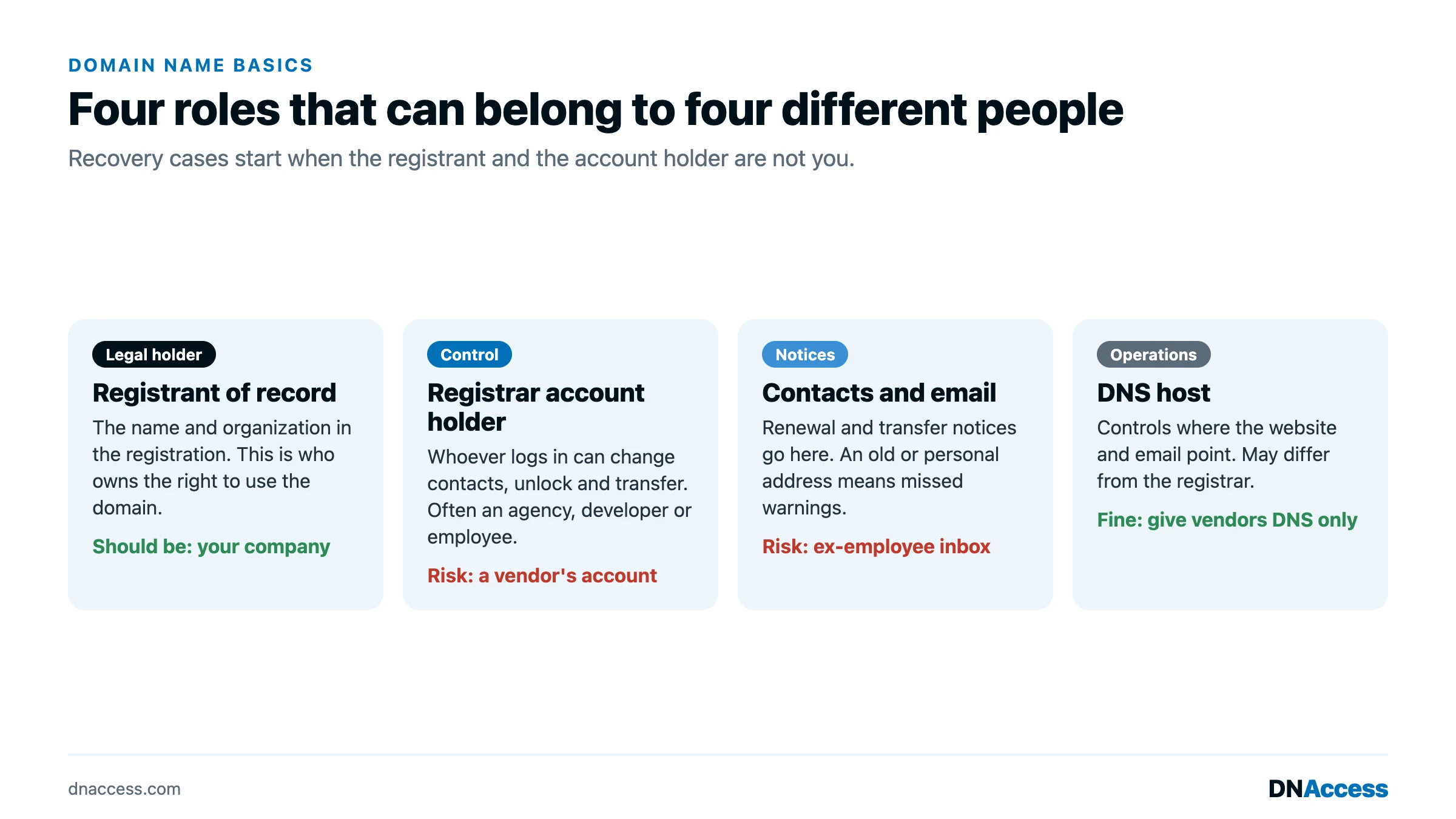
Every registration records a registrant (the person or organization that holds the right to use the domain name). The registrant’s name and, where one is given, organization are the details that registrars, dispute panels and courts look at first when ownership is in question. If the registrant organization field says “Acme Plumbing LLC,” the company has a clear claim. If it says the name of a former office manager, the company has a problem, even if it paid every renewal invoice.
The law treats that registrant interest as real property. In Kremen v. Network Solutions, Inc., 337 F.3d 1024, the Ninth Circuit held in 2003 that a registrant has “an intangible property right in his domain name,” because the interest is capable of precise definition, capable of exclusive possession or control, and supported by a legitimate claim to exclusivity, according to the Ninth Circuit opinion in Kremen v. Network Solutions. The case arose from the theft of sex.com, and it is why a stolen domain can support a conversion claim, not just a contract complaint.
The account holder can be someone else
The registrant is a field in the registration record. The account holder is whoever has the username and password at the registrar. The two are frequently different people.
A web developer registers the domain in the developer’s own account while building the site. A marketing agency buys it on the client’s behalf and keeps it with dozens of other client names. An employee signs up with a personal email address because it was faster. A reseller, such as a web host, holds the registration in its own registrar account and gives the customer a control panel. In each case the business may be named as registrant, or may not, but it does not hold the keys. Because control of the registrar account is control of the domain, the account holder can change the registrant, move the name, or let it lapse.
Registrant, admin, tech and billing contacts
Registration records have traditionally carried four contacts. The registrant is the holder. The administrative contact was authorized to make decisions about the registration, the technical contact handled DNS and server matters, and the billing contact received invoices. Registrars have reduced or merged these roles in recent years, and many no longer collect separate admin and tech contacts at all. Our explainer on registrant, admin, tech and billing contacts walks through what each one means today. The short version: only the registrant contact establishes who holds the name, so it is the one to get right.
How to find out who owns a domain
Looking up who owns a domain name is harder than it used to be. Public registration data was once published in full through WHOIS (the legacy lookup system for domain registration records). Since 2018, privacy law and ICANN policy have caused most registrars to redact personal details, and WHOIS has been replaced for gTLDs by RDAP (the Registration Data Access Protocol, a structured successor that returns the same records in a standard format). Only 10.8% of gTLD domains had identifying contact data for the actual registrant available through registration data services in a 2023 to 2024 sample, according to the Interisle Consulting Group gTLD Registration Contact Data Study.
That does not mean the trail is cold. Start with an RDAP lookup, which shows the sponsoring registrar, the creation and expiration dates, the nameservers, the status codes and, sometimes, the registrant organization and state or country even when the name is redacted. Our guide to RDAP vs. WHOIS explains how to read the result. If the record shows a privacy or proxy service (a service that substitutes its own contact details for the registrant’s), the registrant is still on file with that service, and most services forward messages or respond to legitimate disclosure requests. Next, use the registrar’s contact form, which most registrars offer for redacted records and which relays your message to the registrant. Finally, check WHOIS history, the archived snapshots of past registration records, which often show the registrant’s name from years before redaction began. Our post on websites to check domain name availability lists lookup tools that combine several of these sources.
How to check who owns your own domain, and fix it
Checking your own domain is easier, and worth doing once a year. First, run an RDAP lookup on each domain and note the sponsoring registrar. Then sign in to that registrar and open the contact details for the domain. If you cannot sign in, that is the first finding: someone else holds the account.
Once you are in, check three things. The registrant organization should be the company’s legal name, exactly as it appears on formation documents, not an individual. The registrant email should be a company-controlled, role-based address, such as [email protected], that survives staff changes. And the account itself should belong to the company, with at least two authorized people who use MFA (multi-factor authentication, a second proof of identity at sign-in).
If names are scattered across a developer’s account, an agency’s account and a former employee’s personal account, consolidate them. Moving a name between accounts at the same registrar is usually done with an account change, often called a push. Moving it to a different registrar is a transfer, which requires the authorization code. Changing the registrant name or organization may trigger a confirmation step and, under ICANN’s Transfer Policy, a 60-day block on transfers to another registrar unless the registrant opts out in advance. Our post on how new ICANN policy affects who legally owns your domains covers recent changes to the change-of-registrant rules.
The developer-held domain problem
The most common ownership dispute we see starts with a trusted vendor. A developer or agency registers the domain, or is given access to the registrar account, and later refuses to hand it back over a billing dispute or a falling-out. The business assumed it owned the name because the website was its own. The registration record, or the account, says otherwise.
Make a Home Foundation, a Connecticut nonprofit that furnishes homes for veterans and families in need, lived through this. Its web developer used access to the registrar account to transfer the foundation’s domains to himself and then demanded more money for their return. We documented the foundation’s original registrations and ten years of use, prepared the dispute route and helped with the public campaign. As of November 2026 the developer still controls the foundation’s primary domain, which shows how hard this problem is to reverse once it happens. The full account is in our Make a Home Foundation case study.
Holding a client’s domain as a bargaining chip carries legal risk. In DSPT International v. Nahum, the Ninth Circuit in 2010 affirmed a $152,000 jury verdict against a former employee who registered his employer’s domain and withheld it to extract disputed commissions, holding that holding a domain name for ransom can be bad-faith cybersquatting, according to the Ninth Circuit opinion in DSPT International v. Nahum. Our guide to recovering a domain name held for ransom explains the practical options. Prevention is simpler: give developers DNS access, never registrar ownership, and put in writing that the domain is the organization’s property.
Can you own a domain forever?
No. A domain registration is a right to use a name for a term of one to ten years, and it must be renewed before the term ends. A name can be renewed indefinitely, so a business can hold the same domain for decades, but only if every renewal is paid. If a renewal is missed, the name expires, passes through grace and redemption periods, and is eventually deleted and released to the public, where it is often re-registered within seconds. Ownership of a domain is continuous only as long as the renewals are.
Mistakes that turn into recovery cases
In the cases we handle, three ownership mistakes recur. The registrant field names a person rather than the company. The registrar account belongs to a vendor or former employee. And the contact email is an address nobody at the company monitors, so notices about changes, transfers and expiration never reach the real owner.
How DNAccess helps
Domain name ownership comes down to two facts: who is listed as the registrant and who controls the registrar account. Our domain name background check establishes both, using current RDAP data, WHOIS history and DNS history, whether you are buying a name or confirming your own. When the record already shows someone else in control, our stolen domain name recovery service assembles the ownership evidence and works the registrar, dispute and legal routes. Contact us to review who owns your domains today.