Domain parking is the practice of pointing a registered domain name at a parking provider, a company that displays a placeholder page in place of a real website. The page usually shows advertising links, a notice that the domain is for sale, or both. Parking lets an owner earn a little money from an unused name, or advertise it to buyers, without building a site. For an investor, a parked domain is ordinary inventory. For a business that suddenly finds a parking page on its own domain, it is often the first visible sign that the name has expired or been stolen.
This guide, part of our domain name basics series, explains how domain parking works, how parked domains make money, who parks them, where the trademark risks sit, and why a parking page on your own domain calls for immediate action.
How domain parking works
Every domain has nameservers (the servers that tell the rest of the internet where the domain’s website and email live). To park a domain, the owner changes its nameservers to those of the parking provider, or adds a DNS record (an entry in the domain’s zone that maps the name to a server) pointing to the provider. From that moment, anyone who visits the domain sees the provider’s page instead of the owner’s site. The provider decides what to show based on the domain’s words and the visitor’s location, and it can switch between an advertising page and a for-sale page as the owner prefers. Our guide to nameservers and DNS records explains these settings in more detail.
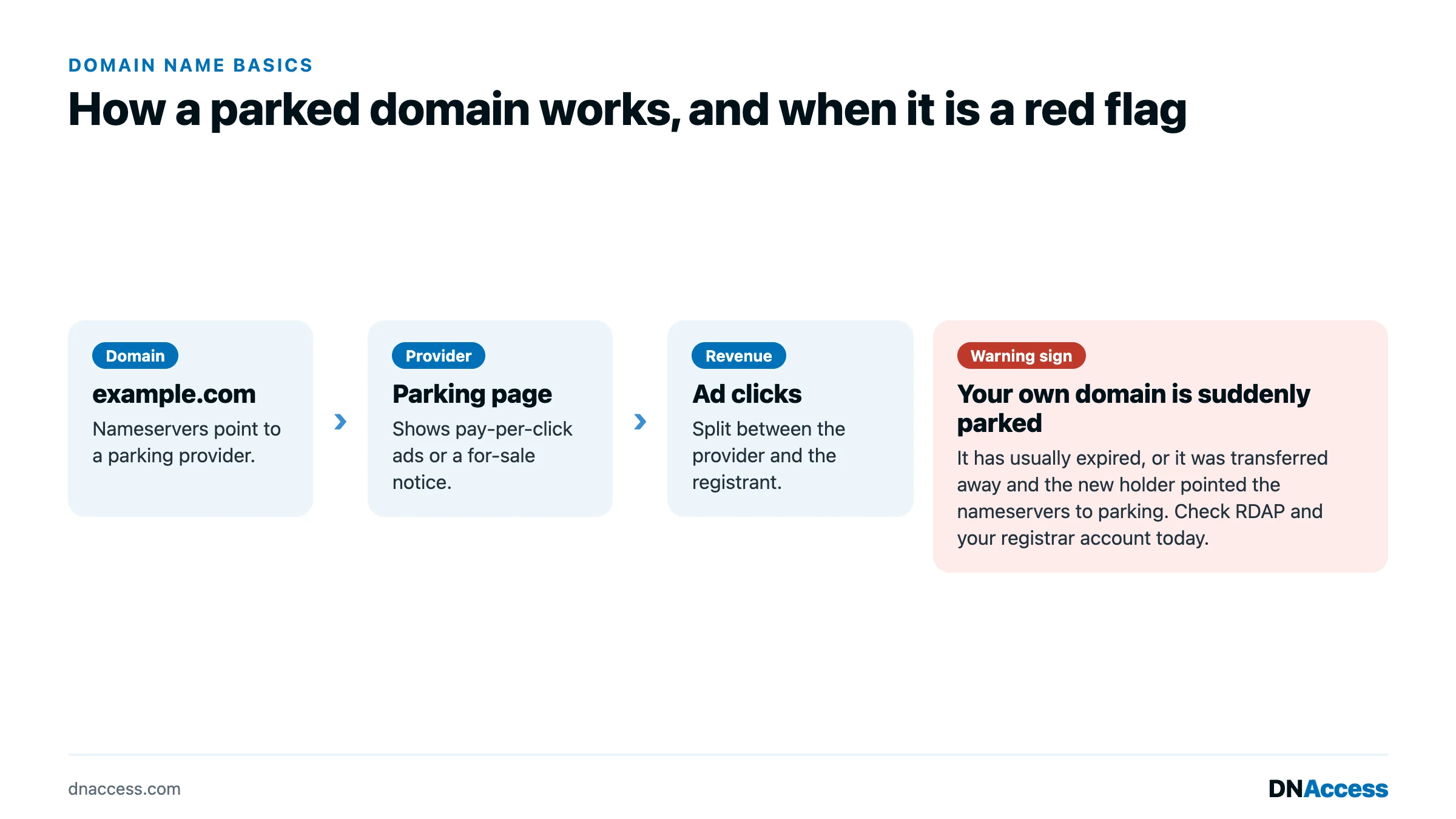
The mechanism matters because it is so simple. A single nameserver change, made in a registrar account in a few seconds, moves a domain from a working website to a parking page. That is useful when the owner makes the change. It is alarming when someone else does.
How parked domains make money
Most parking revenue comes from pay-per-click advertising (ads for which the advertiser pays only when a visitor clicks). The parking provider fills the page with links related to the domain’s words, typically supplied through a large advertising network. When a visitor clicks a link, the advertiser pays the network, the network pays the parking provider, and the provider shares part of that revenue with the domain owner. The split and the payment terms vary by provider.
Revenue depends almost entirely on type-in traffic (visitors who reach a domain by typing it directly into a browser) and on how much advertisers will pay for the topic. A generic name with steady traffic in a commercial category can earn a meaningful sum. Most parked names earn very little, which is why many owners use parking chiefly as a for-sale sign rather than an income source.
Who parks domains
Three groups account for most parked names. Domain investors park their portfolios to collect advertising income and to signal that names are for sale. Registrars park names that have expired: during the grace period after an expiration date, many registrars replace the owner’s website with their own placeholder or advertising page while they wait for a renewal. And ordinary owners park names they registered for a future project and never used, often without realizing that their registrar’s default “coming soon” page is itself a form of parking.
Parking is also where many dropped domains end up. When researchers monitored 28,401,974 pending-delete .com, .net and .org names over nine months in 2017, they found that only about 10% of dropped domains were caught by a new registrant, and that less than 11% of caught domains hosted real web content, according to Miramirkhani and colleagues (WWW 2018). The same study found that previously malicious domains were caught about twice as often as benign ones. Most re-registered names, in other words, are held for parking, resale or worse, not for building a site. Our guide to domain auctions explains how expiring names change hands.
The trademark risk of parking links
Parking pages choose their advertising links automatically, and that automation creates legal exposure. If a parked domain matches or resembles a brand, the provider will often show links to that brand’s competitors. Under the UDRP (Uniform Domain-Name Dispute-Resolution Policy), panels have generally treated pay-per-click links that trade on a complainant’s trademark as evidence of bad faith, and they have generally held the registrant responsible for the content of a parking page even when a provider generated it. Parking a name that targets someone else’s brand is a common element of cybersquatting (registering a domain to profit from another party’s trademark).
The point applies to legitimate investors as well. A dictionary-word domain parked with links that drift toward a famous brand in the same field can draw a complaint that would never have been filed if the page had shown neutral links or a simple for-sale notice.
Why a parking page on your own domain is an emergency signal
If your business website disappears and a parking page appears in its place, assume something is wrong until you prove otherwise. There are two common causes, and both are urgent.
The first is expiration. The renewal payment failed or the reminder went to an old email address, the registration lapsed, and the registrar replaced your site with its own page. You may still be within the grace period, when renewal is straightforward, but the clock is running. Our expired domain name recovery service handles names that have moved past that point.
The second cause is theft. In the domain hijacking cases we handle, the person who takes a domain often points its nameservers at a parking monetization service on the same day the transfer completes. In one matter, a foundation’s domain was transferred out over the five-day transfer window and pointed to a parking service the day the move finished. In another, a creator’s .com was first switched to a parking service and, two weeks later, moved again and resold. Parking gives the thief income and makes the name look like ordinary investor inventory to the next buyer. Our case studies describe how these situations unfold.
To tell the two causes apart, look up the domain in RDAP (the Registration Data Access Protocol, the successor to WHOIS) or WHOIS and check three things: the expiration date, the registrar and the nameservers. An expiration date in the past with your registrar still listed points to a lapse. A new registrar, a recent update date or nameservers you do not recognize point to unauthorized access. Then sign in to your registrar account and see whether the domain is still there.
Mistakes that turn into recovery cases
In the cases we handle, three mistakes recur. Owners ignore the parking page for days, assuming it is a temporary glitch, while the window for an easy fix closes. Owners let renewal notices go to an inbox no one reads, so the first sign of expiration is a parking page that customers report. And owners have no record of their own nameservers and registrar settings, so they cannot quickly show what changed or prove the domain was theirs. Each of these turns a fast correction into a formal recovery.
How DNAccess helps with parked and hijacked domains
The fastest way to catch an unauthorized parking change is to be told about it the moment it happens. DNShield, our domain name monitoring service, watches your domains for changes to nameservers, registrar, registrant data and expiration status and alerts you when they occur. If a parking page has already appeared on your domain because of theft, our stolen domain name recovery service works to restore control, and our expired domain name recovery service handles names that lapsed. Contact us for a quote.