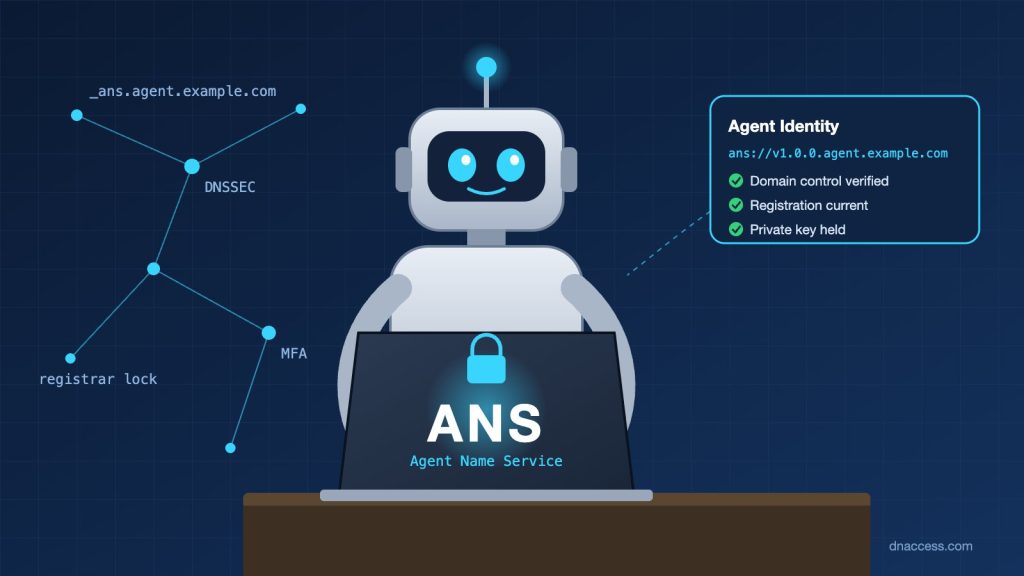
As of November 10, 2026, a company’s domain name is also the identity of its AI agents. That is the practical effect of the Linux Foundation taking over the Agent Name Service (ANS), an open standard backed by 11 organizations, including GoDaddy, Cloudflare, Cisco, DigiCert and Infoblox.
ANS verifies who an AI agent represents by checking the domain it runs on. Control of the domain means control of the agent’s identity. So every weakness we already see in domain security, from a phished registrar login to a forgotten renewal, now carries over to the software that negotiates, buys and signs on a company’s behalf.
The fix is the same work we recommend for any domain that matters, done sooner. In our recovery cases, domains are rarely lost to clever code. They are lost through registrar accounts, expired cards and vendors who hold the login. Those failure points now extend to AI agents.
What the Linux Foundation Announced
The Linux Foundation said in June that it intended to launch ANS. On November 10, at KubeCon + CloudNativeCon North America, it made ANS a formal project under a technical steering committee. The specification runs seven documents covering naming, registration, DNS publication, public log auditing, integrity monitoring and agent-to-agent authentication.
GoDaddy ran the first public ANS registry before the handoff. The AGNTCY Agent Directory Service, another Linux Foundation project, now verifies ANS identities, and Salesforce’s MuleSoft unit has been registering agents.
How the Agent Name Service Ties Agents to Domains
An ANS name looks like this: ans://v1.0.0.payments.example.com. It is a version number placed in front of a hostname the business already controls. According to the project’s own explanation, registration works in three steps:
- The agent operator submits its host, version, endpoints and certificate material.
- A Registration Authority (RA) confirms control of the domain and returns DNS records to publish.
- A transparency log, a public record that cannot be quietly edited, seals each registration event.
Another system talking to that agent then checks three things: the certificate matches the logged registration, the registration is still current, and the agent holds the private key. GoDaddy’s registry adds a business identity check and requires DNSSEC (Domain Name System Security Extensions), which signs DNS answers so they cannot be forged.
The authors of the specification’s IETF draft state the design choice plainly: “The domain is the agent’s permanent address; the version number changes, the domain does not.”
Why This Raises the Stakes for Domain Security
A Hijacked Domain Now Means a Hijacked Agent
Domain hijacking already takes down websites and email. Under ANS, a thief who takes over a domain can also pass the domain control check for that business’s agents. The IETF draft says a new operator registering against a hostname with an active registration triggers revocation of the earlier one. That protects against a stale identity. It also means whoever holds the domain decides which agent is legitimate.
Most thefts we investigate begin with a registrar login. Phishing emails that impersonate ICANN or a registrar are the usual opening move, and fake ICANN verification emails have been circulating again. The same credentials now guard an agent identity.
An Expired Domain Revokes the Agent
The draft treats a domain expiration as a failed validation. The RA treats persistent failure as a security event and revokes the registrations. A missed renewal no longer just takes a website offline. It switches off the company’s verified agents too.
Whoever Holds the Registrar Account Holds the Agent
We regularly see businesses whose domain sits in a developer’s or agency’s account. When that relationship goes bad, the domain becomes leverage, as we described in our post on recovering a domain a web developer refuses to release. If that same vendor sets up a company’s AI agents, the leverage doubles.
What Trademark Owners Should Watch
There is no ANS sunrise period, no reservation window and no claims service. A brand’s protection is the domain portfolio it already holds. Anyone controlling a confusingly similar domain can register a fully verified agent on it.
The IETF draft opens with that exact risk. An attacker registers a look-alike domain, presents a valid certificate, and a payment agent “has no way to tell this impostor from the real supplier.” ANS verifies that an agent belongs to a domain. It does not decide whether that domain should exist. That remains a job for brand protection, domain blocking and UDRP (Uniform Domain-Name Dispute-Resolution Policy) enforcement.
Expect scam offers to “reserve your agent name” before long. ANS sells no such thing.
What This Means for Domain Investors
ANS names are not separate assets. They cannot be registered without a domain, and they do not transfer with one, because each registration is tied to a verified operator. Buying a dropped domain does not buy its former owner’s agent identity. Bill Hartzer covers the investment question in more detail in his analysis of ANS for brand owners and domainers.
What To Do Now
Treat any domain that will host an AI agent as critical infrastructure. Our domain security guide covers each of these in depth:
- Move every business domain into a registrar account the company owns and controls.
- Turn on multi-factor authentication (MFA) and registrar lock, and add registry lock for the domains that matter most.
- Enable DNSSEC on domains that will host agents.
- Set auto-renewal with a current payment method and a monitored contact email.
- Monitor DNS, WHOIS and registrar changes, and watch ANS directories for agents on look-alike domains.
The Agent Name Service puts more weight on the domain name than it has carried since the early days of email. A business that cannot prove control of its domain will soon find it cannot prove who its agents are either.
If your domains are scattered across vendor accounts, sort that out before your first agent goes live. It is far easier than recovering one afterward.