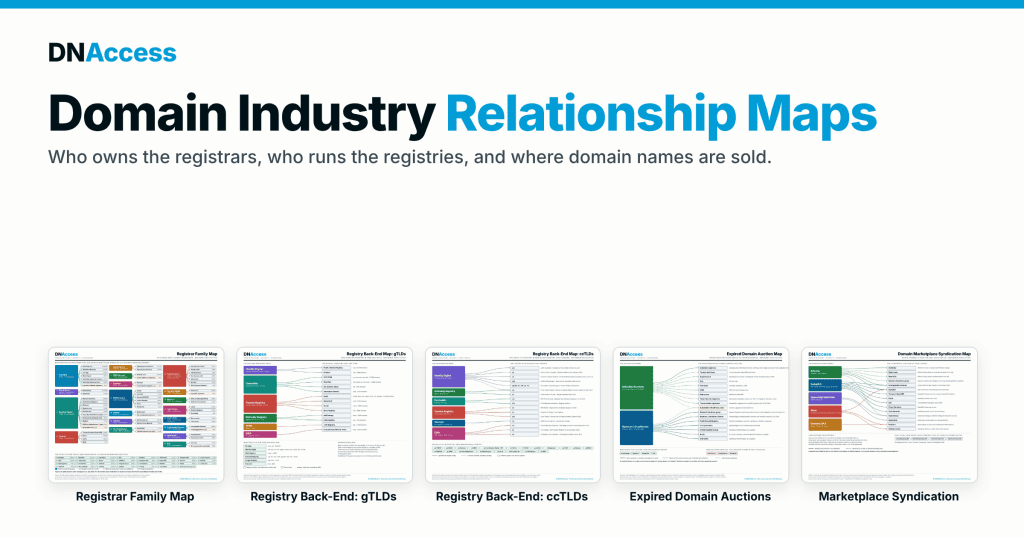
The domain name industry runs on relationships that most domain owners never see. The registrar on your registration record may be a brand owned by a much larger company. The registry behind your top-level domain may hire someone else to run it. An expired domain name is usually sold on a platform the former owner has never heard of. To make those relationships visible, we have published five domain industry relationship maps, each on a single page, each free to print and share.
We built the maps because the same questions open almost every recovery matter we handle. Who really controls this registrar? Who runs this registry? Where did this domain name go when it expired, and where is it being offered for sale? Each map answers one of those questions.
Registrar Family Map
The Registrar Family Map shows who owns which domain registrars. A registrar family is a group of ICANN-accredited registrars under common ownership or control. The map covers the 50 largest families, which together hold 93.1% of all gTLD (generic top-level domain) names, and the 1,986 accreditations they control. It shows the parent behind brands such as Wild West Domains, Enom, Spaceship and Markmonitor, and it shows which companies hold hundreds of numbered accreditations for catching deleted names. When a domain name is transferred without authorization, this is the map that tells you whose abuse desk and legal department actually apply.
Registry Back-End Map: gTLDs
The Registry Back-End Map for gTLDs shows who runs the technical registry behind each of the 50 largest gTLDs. The registry operator holds the contract with ICANN, but a registry service provider often runs the systems. Identity Digital runs .org for Public Interest Registry. CentralNic runs .xyz. Tucows has run .online, .store and .site for Radix since March 2026. Six registries, led by Verisign with .com and .net, run their own.
Registry Back-End Map: ccTLDs
The Registry Back-End Map for ccTLDs does the same for country-code domains. The largest national domains, such as .de and .uk, are run by their own registries. The country codes marketed worldwide are different: .ai, .io, .co, .me, .tv and .cc are all operated by commercial providers. The map also records that .us is moving from GoDaddy Registry to Identity Digital under a contract signed on 30 September 2026.
Expired Domain Auction Map
The Expired Domain Auction Map shows where to bid on or backorder an expiring domain name, based on its registrar. Registrars fall into three tiers. Some send expired names to GoDaddy Auctions or to NameJet and SnapNames. Some, including Namecheap, Dynadot, NameSilo and Unstoppable Domains, auction their own. Others let names delete, which means a backorder with a drop-catching service is the only route. Find the registrar in the domain’s WHOIS or RDAP record, and the map tells you where to go.
Domain Marketplace Syndication Map
The Domain Marketplace Syndication Map shows where a domain name listed for sale can show up. Marketplaces such as Afternic, SedoMLS, Spaceship SellerHub and Atom distribute their listings to partner registrars, so one listing surfaces in the search results at many storefronts. In our test, four registrars showed the same listing at prices ranging from $28,299 to $32,544. That matters to sellers, to buyers, and to anyone whose domain name has been listed for sale without consent.
How the maps were built
Domain counts come from ICANN’s monthly registry reports for July 2026, summed across all 1,114 gTLDs. Registry operation comes from the IANA root zone database. Ownership, auction and marketplace relationships come from the companies’ own disclosures and from trade press, cited on each map’s page. Where a relationship is reported and not confirmed, the map draws a dashed line and the page says so.
Every map page carries a full table, the method, the sources, and downloads in PDF and PNG. The maps may be printed, shared and reproduced free of charge with the DNAccess attribution and the edition date kept in place.
Corrections are welcome
These relationships change. Registrars are acquired, registries change providers, and auction contracts move without announcement. Each map carries its edition date and will be reissued when a relationship changes. If you see something wrong or out of date, contact DNAccess with a source and we will correct the next edition.
Start with the domain industry relationship maps hub, which collects all five maps and their downloads.